
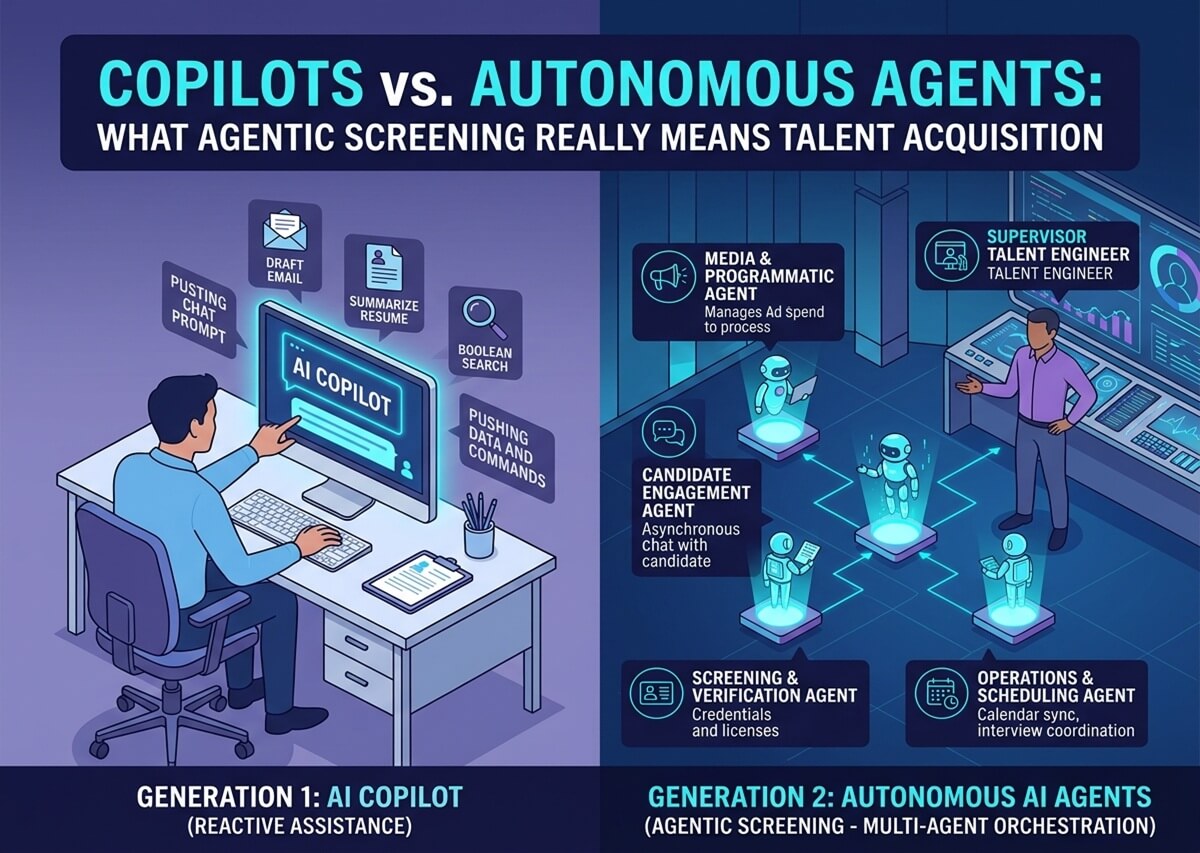
Copilots vs. Autonomous Agents:
If you ask any Talent Acquisition leader about their experience with artificial intelligence over the past few years, you will likely hear a mix of excitement and quiet frustration.
When generative AI first exploded onto the scene, enterprise recruiting departments rushed to adopt chat-based copilots. We were promised that these assistants would transform hiring overnight. In reality, many teams ended up with just another browser tab open. Recruiters found themselves spending hours typing prompts to rewrite job descriptions, draft outreach emails, or summarize long resumes. While these early copilots helped speed up localized writing tasks, they completely missed the bigger picture: recruitment was still bogged down by fragmented systems, manual scheduling delays, and clunky applicant tracking systems that let qualified candidates slip away.
Today, the industry is stepping into a much more meaningful phase: the shift from reactive AI copilots to autonomous, agentic recruiting systems. At the core of this transformation is Agentic Screening: a practical, human-centered approach where AI tools take on complex, multi-step administrative workflows so recruiters can spend less time pushing data around and more time actually talking to people.
The Journey to Autonomous Recruiting Systems
To understand why this shift matters, it helps to look at how hiring technology has evolved in everyday recruiting workflows over the last two decades:
- The Keyword ATS Era: Early Applicant Tracking Systems acted as digital file cabinets. They relied on rigid Boolean keyword matching, which meant a talented candidate could easily get rejected simply because their resume used the phrase “cloud infrastructure” instead of “AWS administration”.
- Predictive Analytics: The next generation introduced basic machine learning algorithms that scored candidate profiles. While this helped rank large pools of applicants, the underlying scoring models were often hard to interpret and did little to reduce the tedious back-and-forth required to verify a candidate’s actual skills.
- Generative Copilots: These tools gave recruiters conversational text generators. They were helpful for drafting individual emails or creating bullet points, but they were entirely reactive. A copilot sat idle until a human gave it step-by-step instructions for every single task.
- Agentic Orchestration: Modern recruiting platforms connect goal-driven AI agents directly into job boards, calendars, and candidate databases. Instead of waiting for a recruiter to type a prompt, an agent is given an objective—such as finding and screening qualified cloud engineers for an open role—and it actively carries out the multi-step process from end to end.
What is the Difference Between a Copilot and an Autonomous Agent?
Think of an AI copilot like a junior assistant who sits beside you but will only move if you give them a specific, line-by-line instruction. You have to tell them what to write, review their work, copy-paste it into another app, and then tell them what to do next. You are still doing all the heavy cognitive lifting.
An autonomous agent, on the other hand, acts like an experienced recruitment coordinator. When you assign a goal to an agent, it breaks the task down into logical steps, uses the software tools connected to it, adapts when things change, and presents you with finished outcomes.
- How work gets triggered: Copilots wait for manual human prompts. Autonomous agents kick into action based on clear goals or automated triggers in your ATS, such as an approved job requisition.
- Memory and context: Copilots operate in isolated chat windows and quickly forget past context once a session ends. Autonomous agents maintain long-term memory across candidate histories, past campaign metrics, and team preferences.
- System integration: Copilots usually live in standalone windows. Autonomous agents plug directly into software APIs—connecting your job boards, communication platforms, and calendars into a single fluid workflow.
- The recruiter’s role: With a copilot, the recruiter acts as a micro-operator managing every single software prompt. With an agent, the recruiter acts as a strategic supervisor setting high-level targets, establishing ethical parameters, and stepping in whenever human judgment is required.
How Agentic Screening Works in Everyday Recruiting
Imagine a candidate applies for a critical role at 10:00 PM on a Friday. In a traditional hiring setup, that application sits in an ATS queue until early next week. By the time a recruiter reviews the resume and sends a follow-up email, the candidate may have already engaged with another company or lost interest entirely.
Agentic Screening rewrites this experience entirely:
- Contextual Profile Analysis: The moment an application comes in, the screening agent looks at the candidate’s background holistically. Instead of hunting for exact keyword matches, it evaluates transferable skills, project responsibilities, and relevant industry experience. If an engineer worked on complex distributed databases under a non-standard title, the agent recognizes that background rather than filtering them out.
- Immediate, Conversational Pre-Screening: Instead of leaving the applicant hanging, the agent initiates an immediate, friendly screening chat through the candidate’s preferred channel, such as SMS or a secure web link. The agent asks a few role-specific questions to confirm practical details like target start dates, shift preferences, compensation expectations, or specialized technical certifications.
- Real-Time Verification: Because job seekers are also using AI tools to polish their resumes, hiring teams face an increasing number of inflated claims. Screening agents help maintain pipeline integrity by cross-referencing professional licensing databases, validating credentials, and flagging unusual data patterns before a recruiter spends valuable time on an interview.
- Human-in-the-Loop Escalation Agents do not make final hiring decisions. If a candidate presents a unique edge case, such as a request for remote work flexibility or non-traditional visa sponsorship, the agent flags the application and hands it off to a human recruiter along with a clear, concise summary.
This immediate engagement makes a massive operational difference. Enterprise hiring teams using agentic screening see up to a 65% drop in candidate drop-off and significantly higher candidate response rates within the first 24 hours.
A Digital Symphony: Multi-Agent Orchestration
In an advanced recruitment setup, you don’t rely on one giant AI bot to do everything. Instead, small, specialized agents work together like members of an organized team:
-
- The Programmatic Media Agent: Keeps an eye on your job board ad spend. If an ad for a difficult role isn’t attracting enough applicants, it automatically reallocates ad budget toward better-performing niche channels to keep candidate volume steady.
- The Candidate Engagement Agent: Acts as a 24/7 concierge on your career site. It answers candidate questions about company culture, benefits, or location requirements in real time, helping applicants complete their submissions smoothly.
- The Screening & Verification Agent: Handles the contextual resume evaluation, conducts conversational pre-screening interactions, and checks credentials to build a verified shortlist.
- The Operations & Scheduling Agent: Takes candidates who pass screening, checks hiring manager calendars via secure integrations, sends out self-scheduling links, and ensures interview prep materials are delivered automatically.
- The Human Recruiter: Takes the qualified, scheduled shortlist, conducts meaningful interviews, evaluates culture fit, and handles offer negotiations.
By letting specialized agents manage administrative handoffs behind the scenes, candidate data moves fluidly through the funnel without getting stuck in human email inboxes.
The Evolution of the Recruiter: Becoming a “Talent Engineer”
When autonomous software handles repetitive administrative tasks, a recruiter’s day-to-day work improves. Recruiters are moving away from spending half their working day doing manual candidate searches and calendar coordination. Instead, they are stepping into strategic roles as Talent Engineers.
A Talent Engineer focuses on four high-impact areas:
-
-
- Designing Workflows & Instructions: Setting clear role criteria, evaluation rubrics, and explicit guidelines for how AI agents should engage with candidates.
- Optimizing Funnel Performance: Looking at candidate journey data to spot bottlenecks, tweaking conversational screening prompts, and making sure recruitment media budgets are spent efficiently.
- Auditing Systems for Fairness: Regularly reviewing AI scorecards to ensure evaluation criteria remain objective, unbiased, and fully compliant with local data privacy laws and pay transparency mandates.
- Building Real Human Relationships: Spending dedicated, uninterrupted time connecting with top candidates, guiding hiring managers, and creating memorable candidate experiences.
-
Keeping Ethics and Trust at the Center
As recruiting technology becomes more capable, keeping strong human oversight in place is non-negotiable. Technology should enhance human decision-making, not replace human empathy.
Enterprise organizations must establish clear operational guardrails:
-
-
- Human-Only Final Decisions: Autonomous agents can source, screen, and schedule, but every final hiring, rejection, and offer decision must be made by a human being.
- Active Bias Prevention: Screening criteria must be grounded strictly in job-relevant competencies, with regular audits to ensure fair evaluation across all applicant demographics.
- Pay Transparency: Automated screening tools must dynamically present required salary ranges based on local municipal and national laws.
- Data Privacy Protection: Candidate data must remain strictly isolated and protected, ensuring personal information is never fed into public training models.
-
Looking Ahead
The shift from assistive copilots to autonomous multi-agent systems is not about replacing human talent acquisition teams—it is about giving them back their time.
By delegating high-volume screening and administrative coordination to smart, well-governed agents, companies can build hiring pipelines that respond instantly to candidate interest. At the same time, recruiters gain the freedom to focus on what matters most: bringing human empathy, relationship-building, and strategic talent selection back to the center of recruitment.