
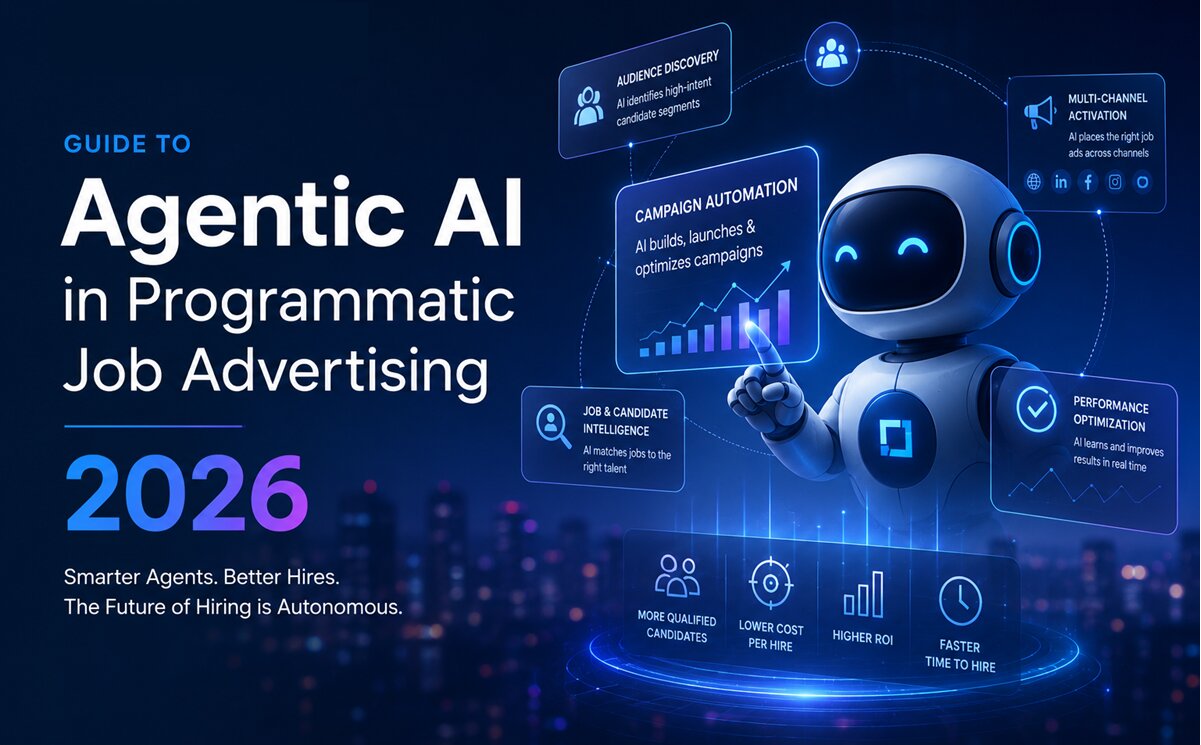
The talent acquisition landscape has officially evolved past traditional automated rules. For the past decade, programmatic job advertising has revolutionized recruitment marketing by introducing “if-this-then-that” rule logic to media buy distribution. Recruiters transitioned from manual posting to rule-based programmatic platforms that throttled budgets based on traffic volume thresholds. However, in 2026, simple rule-based automation is no longer sufficient to secure a competitive edge.
Enter Agentic AI. Unlike the passive, predictive algorithms of yesterday, Agentic AI introduces autonomous, goal-oriented AI agents into your talent acquisition tech stack. These agents do not merely execute pre-configured scripts; they reason, adapt, self-correct, and manipulate complex multi-channel variables in real time to meet high-level strategic objectives. For platforms like Sourcing Square, Agentic AI marks the ultimate transition from manually guided optimization to absolute autonomous execution.
1. Understanding Agentic AI in Recruitment Marketing
To properly integrate Agentic AI into your 2026 sourcing workflow, it is imperative to distinguish it from generative and descriptive AI models. Generative AI models excel at producing content, such as drafting job descriptions or crafting personalized outreach emails. Descriptive and predictive AI models analyze historical datasets to flag trends, such as anticipating when candidate flow will decline. Agentic AI, conversely, is built to execute.
An AI agent is an autonomous software framework capable of processing real-time environmental variables, analyzing multi-step probabilities, and executing workflows to accomplish a predefined goal without human intervention. In programmatic job advertising, instead of a human operator setting explicit bid caps, shifting parameters, or toggling platforms, the recruiter sets a strategic objective. For instance: “Secure 25 qualified senior cloud engineers within a $4,500 budget inside the mid-Atlantic region by the end of the fiscal quarter.”
The Paradigm Shift: Legacy programmatic tools required talent acquisition professionals to build the engine and steer the vehicle. Agentic AI functions as a fully self-driving vehicle—the recruiter simply inputs the corporate destination, and the agent determines the optimal path.
2. Traditional Programmatic vs. Agentic AI: The 2026 Showdown
Many enterprise recruiting teams run standard programmatic software under the assumption that it leverages true machine intelligence. In reality, standard programmatic relies on static thresholds that frequently break down during unexpected shifts in labor dynamics. The table below highlights the operational differences between legacy rule-based platforms and Agentic AI architectures.
| Operational Variable | Traditional Programmatic Advertising | Agentic AI Programmatic Systems |
| Decision Latency | Hourly, daily, or batched updates triggered by fixed limits. | Continuous, millisecond-level updates driven by autonomous reasoning. |
| Content Optimization | Requires manual A/B title testing and human tracking edits. | Autonomously refines job schema, metadata, and alternative titles for GEO/AEO visibility. |
| Budget Management | Shifts capital between predetermined channels via rigid schedules. | Dynamically reallocates capital across thousands of channels based on active quality loops. |
| Error & Incident Management | Flags broken links or low conversion and sends alert logs to HR. | Diagnoses broken integration paths or faulty ATS redirects and self-corrects links instantly. |
| Learning Continuity | Static framework until custom code updates or manual adjustments are configured. | Continuously improves baseline logic by ingesting full-funnel downstream hiring outcomes. |
3. The Four Pillars of Agentic AI in Job Advertising
Agentic AI platforms do not function via a singular code script; they deploy an orchestrated swarm of localized specialized agents. Within an enterprise platform like Sourcing Square, the agentic architecture stands upon four fundamental structural pillars:
Pillar A: Autonomous High-Frequency Micro-Bidding & Fluid Budgeting
Traditional programmatic bidding relies on macro-level rules—such as lowering bids when an ad receives 50 clicks. Agentic AI operates on high-frequency predictive modeling. The bidding agent processes localized cost patterns across aggregators (Indeed, ZipRecruiter), premium networks (LinkedIn, niche publications), and localized ad networks simultaneously. If a specific source experiences an abrupt surge of qualified engineering traffic, the agent routes capital to that source within milliseconds. If candidate conversion stalls, the agent redirects the budget to prevent cost-per-click bleed.
Pillar B: Generative Engine Optimization (GEO) & Next-Gen Search
In 2026, candidate search behaviors have structurally evolved. Rather than searching Google or navigating traditional job site fields, candidates leverage interactive AI discovery workflows (such as ChatGPT Search, Perplexity, Gemini, and corporate AI voice channels). Agentic AI frameworks understand how large language models index and recommend structured employment opportunities. The agent acts autonomously to modify underlying schema configurations, adjusting syntax and terminology on the fly to maximize contextual indexing, ensuring your organization’s open roles rank as top solutions for natural language talent queries.
Pillar C: Full-Funnel Quality Loop Integration
Legacy programmatic systems often create a “quantity over quality” crisis. By maximizing traffic vectors blindly, they deliver massive waves of unverified resumes that overwhelm downstream recruiting teams. Agentic AI addresses this through end-to-end integration with enterprise Applicant Tracking Systems (ATS). The agent maps application metadata directly against intermediate and final recruitment milestones (e.g., passing pre-screens, scheduling hiring manager interviews, or receiving formal offers). If a job board yields thousands of cheap clicks but zero hires, the agent down-weights that channel, altering the bidding parameters to target channels that exhibit reliable, deep-funnel success.
Pillar D: Contextual Sourcing Spotters
Enterprise recruitment marketing cannot rely solely on standard candidate destinations. Contextual spotter agents continuously map peripheral, unstructured digital spaces, including targeted technology Slack communities, Discord channels, professional forums, and Github localized repositories. When an open requisition requires high-specialization talent, the spotter agent deploys micro-targeted programmatic display assets directly within the precise contextual digital hubs where that precise cohort congregates.
4. Tangible Business Benefits for Enterprise Sourcing
Transitioning from legacy rule automation to an enterprise Agentic AI stack drives significant operational efficiencies and financial advantages across the talent ecosystem:
- Elimination of Idle Budget Waste: Traditional programmatic campaigns suffer from massive weekend and holiday budget bleed because manual overrides remain offline. AI agents operate continuously, modifying bids 24 hours a day, 7 days a week, ensuring zero lost budget.
- Significant Slashing of CPQA: By aggressively pruning non-converting platforms and focusing on deep-funnel conversion metrics, enterprise companies moving to agentic job deployment typically observe a 30% to 50% reduction in overall cost-per-qualified-applicant (CPQA).
- Drastic Reduction in Sourcing Overhead: Talent acquisition operations teams often spend hours building intricate spreadsheet calculations and rule matrices. Agentic frameworks handle data processing automatically, liberating internal talent teams to focus exclusively on relationship management and human candidate interactions.
- Enhanced Sourcing Penetration for Hard-To-Fill Roles: For ultra-niche domains, such as quantitative research, deep-tech AI development, or specialized clinical medicine, agents locate hyper-specific target audiences across hidden distribution channels that human talent acquisition resources lack the bandwidth to monitor.
5. Technical Architecture & ATS Integration Blueprint
A primary hurdle to adopting Agentic AI is the fear of upending established software stacks. However, platforms like Sourcing Square act as intelligent overlay networks that sit securely atop your current technology foundational layer. The execution architecture relies on two synchronization pathways:
1. Outbound Publisher Distribution: The Agentic AI layer maintains open API integrations across global job boards, social media advertising structures, and ad exchanges. This ensures real-time adjustments to bids, campaign updates, and immediate active pauses across all platforms simultaneously.
2. Inbound ATS Webhooks: Deep integration with core ATS infrastructure (such as Workday, Greenhouse, Oracle Recruiting Cloud, and SAP SuccessFactors) enables the platform to receive instantaneous status signals. The moment a candidate advances from ‘Applied’ to ‘Qualified Screen Complete’ in the ATS, the feedback agent processes the attribution data and updates the bidding agent to acquire similar candidate personas.
6. Guardrails, Compliance, and Algorithmic Governance
Allowing an autonomous engine to handle corporate recruitment budgets requires strict corporate governance and clear ethical parameter control. Enterprise deployment must include three strict structural guardrails:
- Financial Sandboxing: Autonomy does not imply unchecked financial authority. Enterprise teams set absolute financial barriers, including daily spend ceilings, hard monthly campaign caps, and pre-approved publisher whitelists. The AI agent executes optimizations strictly within these human-defined parameters.
- Algorithmic Transparency & Blind Bidding: To satisfy modern data regulatory environments (such as the EU AI Act, NYC Local Law 144, and global EEO guidelines), recruitment agents must be programmed with absolute demographic anonymity. The agent monitors purely behavioral, performance, and conversion datasets, ensuring that budget optimization remains completely objective, equitable, and compliant.
- Autonomous Circuit Breakers: Modern agentic software includes real-time anomaly detection. If an agent detects a sudden, irregular spike in bidding pricing or unusual traffic patterns, it pauses the affected ad routing instantly and triggers a system notification for human verification, preventing systemic software exploitation.
Conclusion:
Programmatic job advertising successfully changed where and when organizations distributed their open vacancies. Now, Agentic AI is revolutionizing how those campaigns are analyzed, optimized, and won. By relinquishing rigid, manual, rule-based paradigms and deploying goal-seeking, autonomous agents, enterprise talent acquisition leaders can systematically eradicate financial waste, outpace volatile labor market disruptions, and position their job opportunities at the absolute forefront of modern AI-powered candidate discovery. The future of global recruitment marketing is no longer simply automated—it is agentic.