
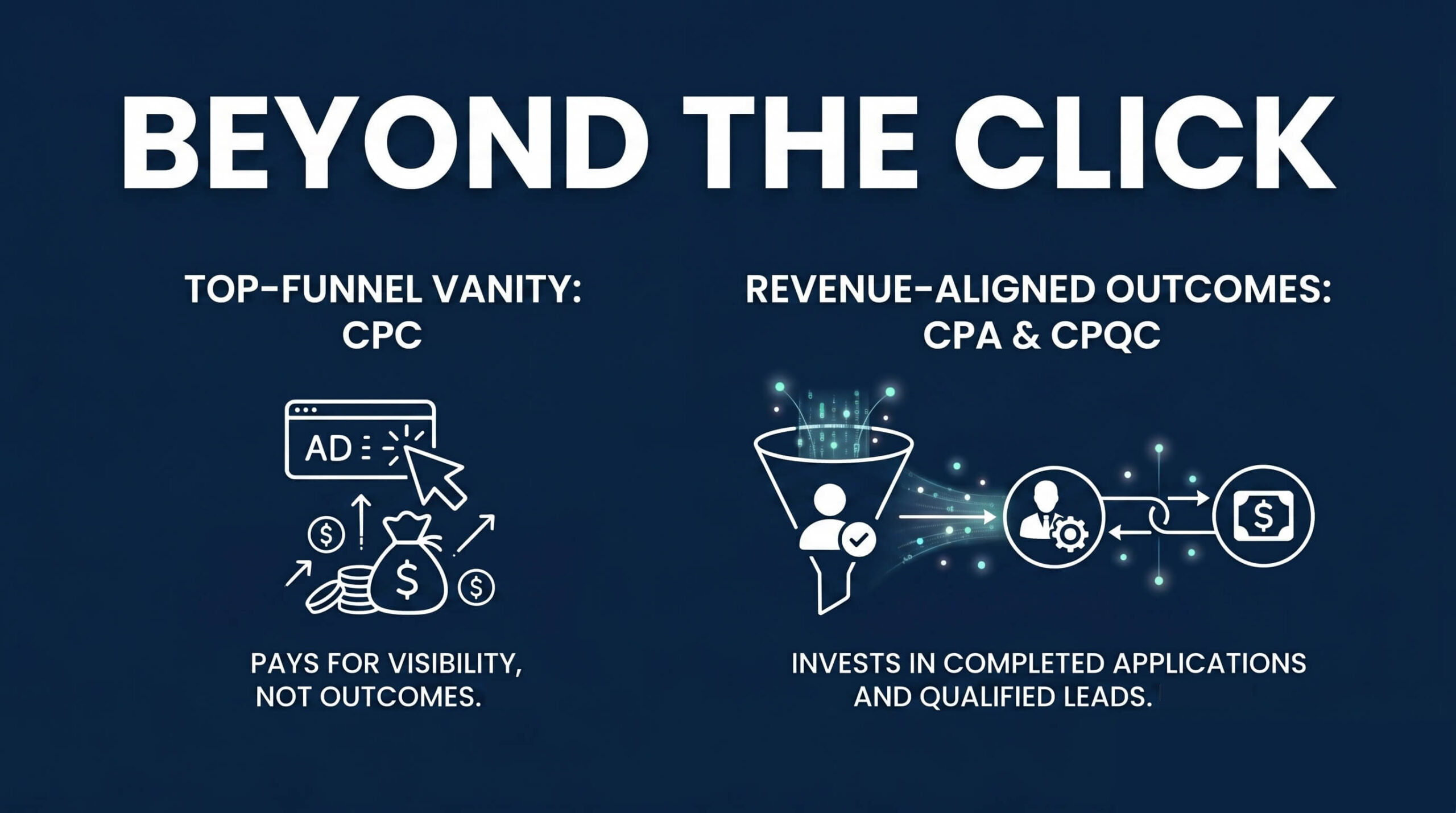
Beyond the Click: The Recruitment Advertising Metrics That Actually Matter
For years, Talent Acquisition teams have treated Cost-Per-Click (CPC) as the ultimate yardstick for recruitment marketing success. It makes sense on paper: you want to know how much it costs to get eyes on your job descriptions. But relying solely on CPC is like judging a restaurant entirely by how many people walk past its front window. In a landscape transformed by algorithmic job matching, surging application rates, and tight corporate budgets, optimizing for cheap clicks is a fast track to wasted spend.
The data confirms this mismatch: recent recruitment marketing benchmarks show that while click-through rates fluctuate, an influx of clicks often yields nothing more than a flooded applicant tracking system (ATS) full of unqualified profiles. To build a high-performance talent pipeline, recruitment teams must look further down the funnel. Here are the core metrics your team needs to track beyond the click to ensure your budget delivers business-critical hires.
1. Cost-Per-Application (CPA)
If CPC tells you who looked, Cost-Per-Application (CPA) tells you who cared. CPA measures the total advertising spend divided by the number of completed applications received.
CPA = Total Ad Spend / Total Completed ApplicationsWhy It Matters
A job board might offer an incredibly low CPC, but if the candidate experience on that platform is riddled with friction, 90% of those users will drop off before hitting submit. If you spend $500 on 1,000 clicks ($0.50 CPC) but only 5 people finish the application, your CPA is a staggering $100. Conversely, a platform with a $2.00 CPC that yields a 20% conversion rate gives you a $10 CPA.
Tracking CPA allows programmatic engines to dynamically shift your ad budget away from high-bounce platforms toward sources where active candidates are truly engaged.
2. Cost-Per-Qualified Candidate (CPQC)
With the rise of AI-assisted job hunting, apply rates have climbed across many white-collar and specialized fields. While a high volume of applications looks great on an HR dashboard, it often creates an admin bottleneck for internal recruiters trying to screen out spam. This is where Cost-Per-Qualified Candidate (CPQC) comes in.
Why It Matters
CPQC filters out the noise by calculating ad spend against only the applicants who pass your baseline screening parameters (e.g., minimum experience, specific certifications, or geographic requirements). If Channel A and Channel B both generate a $15 CPA, but Channel A’s applicants fail basic screening 90% of the time, your real talent acquisition cost on Channel A is wildly inflated. Tracking CPQC highlights exactly which channels are sending high-intent talent.
3. Apply Start Rate vs. Apply Completion Rate
Tracking the drop-off inside your application pipeline reveals flaws in your candidate user experience.
- Apply Start Rate: The percentage of users who click “Apply” and look at your application form.
- Apply Completion Rate: The percentage of those starters who complete the process.
Why It Matters
Benchmark data indicates that cross-channel apply start rates sit around 40%, but completion rates collapse when forms are overly complex. If your metrics show a massive gap between starts and completions, your ad spend isn’t the problem—your application process is. Keeping forms streamlined and mobile-friendly ensures you aren’t paying for traffic that abandons you at the finish line.
4. Down-Funnel Conversion Rates (CVR)
Your recruitment advertising shouldn’t stop tracking data at the application gate. To accurately judge the health of your sourcing engine, look at the transition metrics between hiring stages:
- Application-to-Screen Rate
- Screen-to-Interview Rate
- Interview-to-Offer Rate
Why It Matters
If your programmatic media campaigns are aligned with your ideal candidate personas, your down-funnel conversion rates will remain steady. A sudden drop in your screen-to-interview conversion rate is an early indicator that your job ad messaging is attracting the wrong segment of the workforce, prompting a quick pivot in your automated bidding strategy before the budget is depleted.
5. Channel-Specific Cost-Per-Hire (CPH)
Cost-Per-Hire is the definitive metric for talent acquisition teams, balancing total internal and external recruiting costs against the volume of actual hires made. However, to maximize the performance of your marketing, you must isolate your advertising-specific CPH by channel.
Advertising CPH per Channel = Total Ad Spend on Channel / Hires Sourced from ChannelWhy It Matters
A holistic view reveals where your actual business revenue is generated. It’s common for talent acquisition leaders to discover that 70% of their ultimate hires originate from just 20% of their active ad channels. Isolating your CPH by channel gives you the hard data required to eliminate flat-fee job boards that yield zero placements and move toward automated, rules-based bidding models.
Moving Beyond the Click with Sourcing Square
Relying purely on top-of-funnel metrics like CPC leaves your team blind to true recruitment ROI. By implementing end-to-end data tracking from click to close, you remove the guesswork from talent acquisition.
Sourcing Square connects directly to your applicant tracking systems to automatically monitor downstream metrics. Our programmatic algorithms leverage this data to allocate your recruitment ad spend in real-time, buying outcomes and qualified talent rather than unoptimized traffic.