
The Death of “Post and Pray”
For decades, enterprise talent acquisition has operated on a static model: buy a 30-day slot on a commercial job board, paste a standard description, and wait. This “post and pray” approach once worked when candidate distribution was centralized across two or three major career hubs. In today’s fragmented hiring market, it is one of the single largest drains on enterprise talent acquisition budgets.
Up to 65% of recruitment ad spend is wasted on roles that do not need paid promotion, while critical, specialized requisitions remain vacant for months. The issue is structural: legacy job boards charge flat fees regardless of performance, candidate quality, or real-time hiring needs.
Programmatic recruitment advertising changes this dynamic by applying real-time data, algorithmic bidding, and automated budget pacing to job distribution. By replacing static job slots with dynamic budget allocation, enterprise teams routinely cut their Cost-Per-Hire (CPH) by up to 45% while tripling qualified applicant flow.
The Three Hidden Costs of Traditional Job Boards
Relying on manual job distribution and duration-based listings introduces systemic inefficiencies that silently inflate your recruitment costs.
1. The Flat-Fee Illusion
Whether a 30-day posting generates two applicants or two hundred, traditional job portals charge the exact same flat fee. When a position is filled in three days, the remaining 27 days of paid placement provide zero marginal value to your organization.
2. The High-Volume Budget Drain
Easy-to-fill positions (such as customer service, entry-level sales, or general logistics) naturally attract high application volumes. When placed on flat-rate or unmanaged daily-budget campaigns, these requisitions continue consuming ad dollars long after the hiring team has enough qualified profiles to conduct interviews.
3. Starved Hard-to-Fill Roles
Because entry-level and high-volume postings disproportionately consume available ad budgets, technical, executive, and specialized roles are often left with inadequate promotion. Talent teams end up paying expensive agency placement fees or purchasing emergency premium upgrades to compensate.
What Is Programmatic Job Advertising?
Programmatic job advertising uses software and algorithmic bidding to automate the purchase, placement, and performance optimization of job postings in real time—eliminating the need for manual contracts with individual job boards.
Instead of paying a fixed price per posting, programmatic platforms operate on performance-based models like Cost-Per-Click (CPC) or Cost-Per-Application (CPA). Job ads are distributed across an ecosystem of hundreds of publishers, social networks, and search engines, targeting candidates where they actually spend time online.
Most importantly, modern programmatic engines continuously analyze incoming applicant flow against predetermined targets, automatically adjusting bids to favor requisitions that require immediate candidate volume.
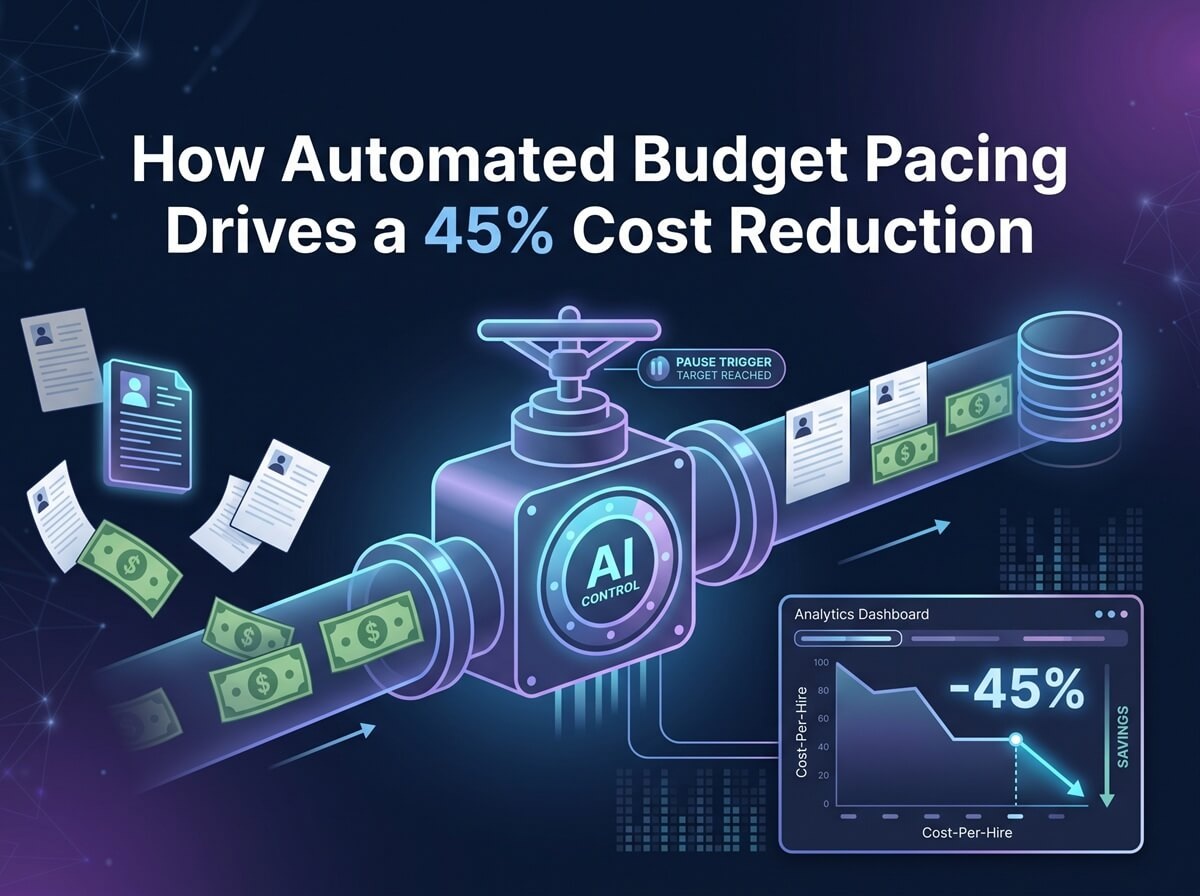
How Automated Budget Pacing Drives a 45% Cost Reduction
The primary driver behind programmatic cost savings is automated budget pacing—an intelligent control layer that ensures ad dollars are deployed only where they generate measurable return.
Dynamic Applicant Caps
Rather than running campaigns indefinitely, hiring teams establish specific candidate volume thresholds directly within their ATS or programmatic dashboard (for example, setting a target cap of 40 qualified applicants for a regional operations manager).
The moment that 40th candidate submits an application, the system automatically pauses distribution across all advertising channels.
Real-Time Capital Reallocation
Under manual workflows, paused ad dollars simply expire or sit unallocated. Automated budget pacing instantly redirects those surplus funds toward under-indexed, hard-to-fill requisitions.
Specialized roles receive the distribution push they need without requiring recruiters to request supplementary budget approvals or manually adjust campaign settings.
Algorithmic Publisher Selection
Not every job board delivers the same candidate quality for every role. Programmatic software evaluates candidate conversion rates across more than 100 publisher networks simultaneously.
If Publisher A delivers low-cost but unqualified clicks while Publisher B generates interview-ready applicants, the system shifts budget directly toward the channel delivering higher hiring yield.
Key Performance Comparison
| Metric | Traditional “Post and Pray” | Automated Programmatic Advertising |
| Pricing Model | Fixed flat fee (per 30-day slot) | Performance-based (CPC / CPA) |
| Budget Management | Manual reallocation and static budgets | Automated, real-time budget pacing |
| Distribution | 1–3 siloed job boards | 100+ targeted channels simultaneously |
| Spend Efficiency | 50%–65% spent on over-subscribed roles | Zero ad spend on completed targets |
| Average Cost-Per-Hire | Industry baseline | Up to 45% lower |
| Qualified Candidate Flow | Variable and unpredictable | 3x higher conversion rate |
4 Steps to Modernize Your Recruitment Ad Spend
Transitioning from static job postings to automated programmatic distribution does not require overhauling your existing HR infrastructure.
- Audit Your Current Spend Distribution: Analyze your trailing 12-month job advertising receipts. Identify how much capital was allocated to roles that achieved their hiring targets within the first two weeks of posting.
- Standardize Target Applicant Caps: Work with talent acquisition leaders to establish target applicant thresholds by job family. A software engineering requisition may require 30 qualified applicants to secure a hire, while a specialized field technician role might only require 15.
- Connect Your ATS via Automated Job Feeds: Implement a programmatic platform that integrates directly with your Applicant Tracking System. This allows open requisitions to be indexed, distributed, updated, and closed automatically without manual recruiter intervention.
- Activate Performance-Based Bidding Rules: Set maximum CPA targets and let intelligent pacing algorithms manage day-to-day channel selection and spend balancing across your requisition portfolio.
Enterprise recruitment can no longer afford the financial waste and operational drag of static job board postings. By switching to automated budget pacing and programmatic distribution, talent acquisition teams protect their ad budgets, eliminate manual campaign management, and consistently deliver qualified candidate pipelines at a fraction of the cost.
Ready to stop budget leakage and modernize your hiring campaigns? Schedule a platform walkthrough with Sourcing Square today at sourcingsquare.com.