
By 2026, programmatic job advertising will no longer be a novelty or a “shiny new tech” line item in the talent acquisition budget. It is the baseline framework for how enterprise organizations distribute their open requisitions.
However, a glaring issue remains: most companies are still optimization-blind. Many talent acquisition (TA) teams have simply automated their old, inefficient habits. They treat programmatic platforms like faster versions of legacy job boards—throwing a flat budget at a network, praying for traffic, and evaluating success based on completely obsolete metrics.
If your core metric for recruitment marketing success is still raw impressions or Cost-Per-Click (CPC), you are fundamentally losing the ROI game. In 2026, optimizing programmatic recruitment ad spend requires a data-driven approach that ties every single dollar directly to pipeline quality.
This ultimate guide delivers the actionable playbook for squeezing maximum ROI out of your programmatic job advertising engine.
1. Retiring the Vanity Metrics: The Shift to CPQC
To optimize ROI, you must first change how you measure it. For years, vendors sold recruitment marketing on top-of-funnel volume. But thousands of clicks and hundreds of unstructured, single-click mobile applications don’t fill empty desks; they just build administrative bottlenecks for your sourcing team.
In 2026, high-performing TA teams have completely decoupled their strategies from Cost-Per-Click (CPC). The modern standard for optimization is Cost-Per-Qualified-Candidate (CPQC).
The ROI Reality Check: A channel that delivers 500 clicks at $0.50 each ($250 total spend) but results in zero candidates passing your hiring manager’s pre-screen has an ROI of exactly 0%. A channel that delivers 5 clicks at $50 each ($250 total spend) but results in 3 interview-ready, credentialed professionals has an infinitely higher yield.
Optimizing for CPQC forces your programmatic engine to judge media channels not by how much noise they create, but by the downstream value they deliver inside your Applicant Tracking System (ATS).
2. Implementing Multi-Tiered Programmatic Caps
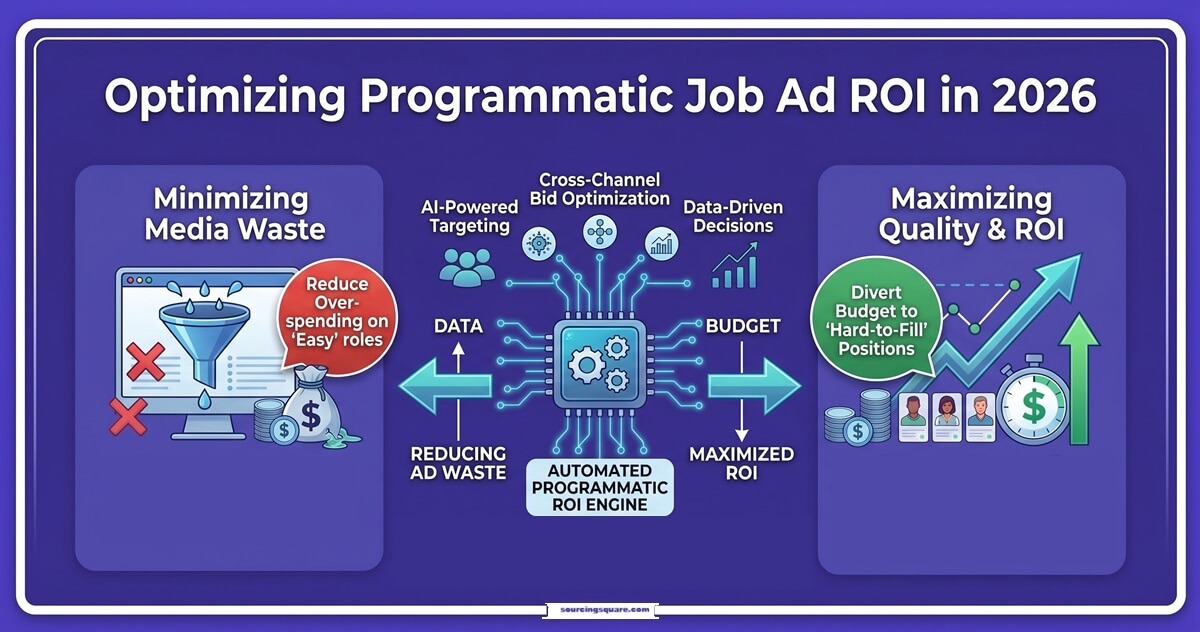
The fastest way to instantly boost your programmatic ROI is to eliminate budget bleeding on your easiest-to-fill positions.
Without explicit boundaries, job aggregator algorithms will naturally herd traffic toward high-volume, general-interest roles (such as entry-level administrative, retail, or remote support positions). These roles accumulate clicks rapidly, draining your centralized budget pool within days while your highly technical or localized, hard-to-fill roles sit completely starved for visibility.
To stop this, your media strategy must deploy automated, multi-tiered programmatic caps:
- Application Volume Caps: Set a hard ceiling on the maximum number of applications an easy-to-fill role can accept before the system automatically pauses the ad distribution. If 40 applications are historically enough to yield a quality hire for an account manager role, configure the system to cut off spend the exact second application number 40 lands.
- Daily Spending Sandboxes: Restrict high-velocity roles to small daily financial limits (e.g., maximum $10–$15 per day). This slows down the consumption of capital, allowing your harder, niche requisitions a continuous window of visibility across the billing cycle.
- Downstream Status Caps: The gold standard of 2026 automation. Rather than capping spend based on raw application count, configure your programmatic engine to keep a job listing active until a specific number of candidates successfully advance to the “Interview Scheduled” or “Hiring Manager Review” stage inside your ATS.
3. Algorithmic Budget Routing and Portfolio Management
Optimizing programmatic ROI means viewing your open requisitions not as individual silos, but as a dynamic financial portfolio. When a programmatic cap triggers and pauses a campaign for an easy-to-fill role, that money shouldn’t sit on the sidelines—it must be instantly recycled.
Modern programmatic systems use real-time, multi-channel arbitrage to route saved capital into under-indexed, high-priority requisitions automatically.
For instance, if your software engineering or senior clinical roles are lagging behind their target pipeline curves, the system should algorithmically increase their bid thresholds using the funds saved from your capped administrative roles. This shifts your talent acquisition framework from a passive “post-and-pray” model to an aggressive, hyper-targeted digital media buying desk.
4. The 2026 Programmatic ROI Optimization Matrix
To help your team systematically audit and configure your recruitment media portfolio, use this optimization matrix to segment your open requisitions:
| Campaign Type | Typical Waste Profile | Primary Optimization Lever | Expected ROI Impact |
| High-Volume / Low Scarcity (e.g., Retail, Customer Service, Entry Sales) | Massive over-spending; hundreds of excess, unreviewed resumes. | Tight Application Volume Caps + Low Daily Financial Sandboxes. | 35% to 45% reduction in total media waste; immediate drop in recruiter screening hours. |
| Steady-State / Mid-Tier (e.g., Core Engineers, Financial Analysts, Project Managers) | Moderate click conversion but highly variable candidate quality. | Downstream Status Caps tied to ATS Pre-Screen passes. | 20% improvement in overall pipeline quality; predictable cost-per-hire stabilization. |
| Hyper-Niche / High Scarcity (e.g., Cloud Architects, Specialized Physicians, AI Research Directors) | Severe under-indexing; suppressed visibility due to low natural click volume. | Uncapped Dynamic Bidding + Bid Escalation via recycled Tier 1 capital. | Significant drop in Time-to-Fill; increased top-of-mind visibility on premium/niche channels. |
5. The Critical Layer: Closed-Loop ATS Integration
You cannot achieve true programmatic ROI optimization if your marketing engine is disconnected from your core recruitment pipeline. True efficiency relies entirely on building a closed-loop feedback system.
Your programmatic vendor must integrate deeply with your enterprise ATS (e.g., Workday, iCIMS, Greenhouse) via real-time webhooks.
[ Programmatic Platform ] ───► Bids & Distributes Ads ───► [ Job Boards & Aggregators ]
▲ │
│ (Real-Time Bid Adjustments Based on Quality) ▼
[ Closed-Loop Webhook ] ◄─── Filters Out Unqualified ◄─── [ ATS Screen / Knockout Questions ]
When a candidate applies through a programmatic ad, the ATS must immediately feed tokenized data back to the marketing engine. If the candidate fails a basic knockout question (such as lack of required licensure or geographic restrictions), the programmatic engine notes that specific channel source as “Low Quality.”
Conversely, when a candidate passes screens and moves down the funnel, the programmatic engine receives a value confirmation signal. Over time, the platform’s algorithms learn exactly which publisher networks, sub-sites, geolocations, and day-parts yield your highest-converting hires, automatically blacklisting low-performing channels and maximizing your media yield.
Conclusion: Take Control of the Machine
Programmatic job advertising is incredibly efficient, but it requires a strategic pilot. If you allow job search engines and aggregators to decide how your budget is spent without strict caps and down-funnel tracking, they will optimize for their bottom line—which is maximizing click volume.
By taking control of the machine—shifting your north star metric to CPQC, enforcing programmatic caps on easy roles, algorithmically routing budget to hard-to-fill vacancies, and leveraging a closed-loop ATS data sync—you transform your recruitment marketing from an unpredictable cost center into a precise, value-driven hiring engine.