
In 2026, relying on a single talent attraction channel is a guaranteed recipe for inflated cost-per-hire and pipeline bottlenecks (learn more on how to cut cost-per-hire using data automation). While traditional job boards still capture active job seekers, over 70% of the potential talent pool remains passive—navigating professional feeds, vertical video platforms, and display networks without ever visiting a career site. High-performing Talent Acquisition (TA) (see our Ultimate Guide for Talent Acquisition Leaders 2026) teams operate as digital media buying desks, dynamically orchestrating ad dollars across active and passive channels to build predictable, multi-touch hiring funnels.
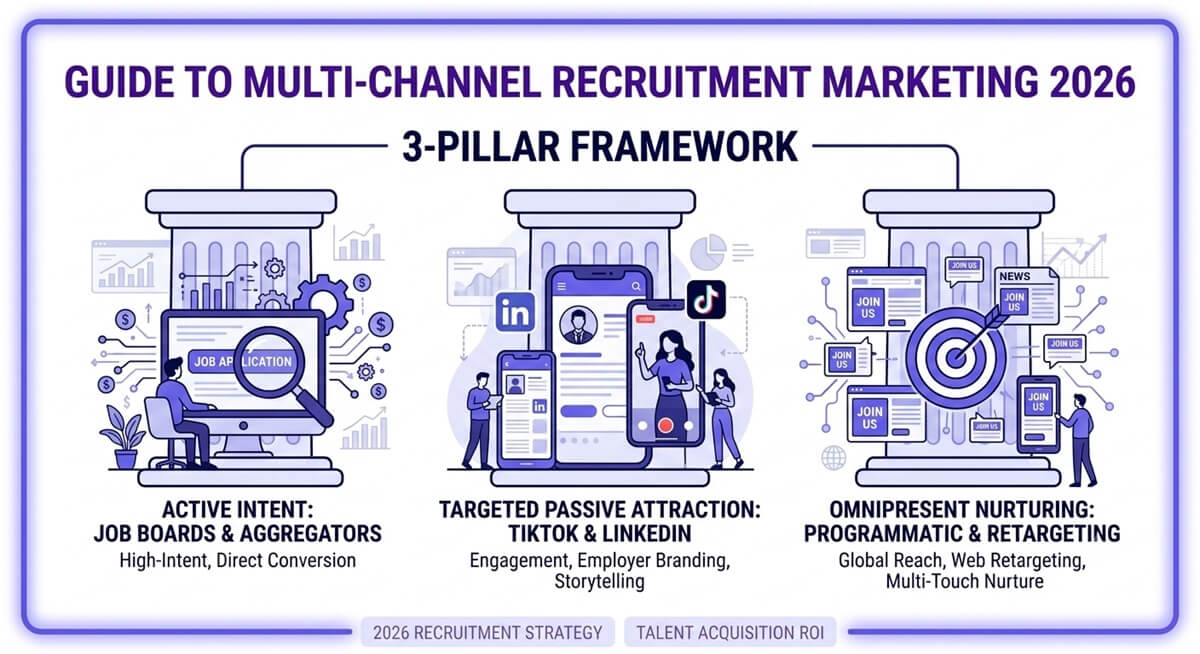
1. The 3-Pillar Recruitment Channel Framework
To achieve optimal multi-channel efficiency, talent acquisition leaders must evaluate media channels not by total traffic volume, but by candidate intent level and placement in the recruitment funnel.
- Traditional Job Boards & Aggregators (Active Intent): Platforms like Indeed, ZipRecruiter, and niche industry boards capture high-intent candidates actively seeking immediate employment. They serve as the baseline bottom-of-funnel conversion engine, but yield diminishing returns when market supply for specialized roles is low. To maximize efficiency here, you must automate job postings across multiple job boards and focus on eliminating wasteful job board spend.
- Social Media Recruitment (Targeted Passive Attraction): Channels like LinkedIn and TikTok reach passive professionals who are not actively searching job sites. LinkedIn targets professional networks and executive talent via career histories and industry authority, while TikTok and Meta engage early-career, creative, and frontline talent through short-form video storytelling and authentic Employer Value Proposition (EVP) content.
- Programmatic Display & Web Retargeting (Omnipresent Nurturing): Programmatic ad networks distribute targeted banner and native display ads across consumer news, lifestyle, and industry web properties. By leveraging web pixel and identity matching, programmatic display retargets candidates who visited your career page but abandoned their application, keeping your employer brand top-of-mind across the broader web. (Discover how programmatic advertising enhances employer branding).
2. Dynamic Budget Allocation Strategy
Allocating recruitment ad spend requires a tailored strategy based on role complexity, market scarcity, and candidate seniority. Static, flat-fee posting budgets waste capital on easy-to-fill positions while under-funding critical roles. The following budget allocation matrix outlines optimal spend distribution across standard hiring scenarios:
| Hiring Scenario | Job Boards & Aggregators | Social Media (LinkedIn / TikTok) |
Programmatic Display & Retargeting |
| High-Volume / Frontline |
45% | 35% (TikTok / Meta Heavy) |
20% |
| Niche / Technical / Engineering |
20% | 50% (LinkedIn / GitHub Heavy) |
30% |
| Executive & Senior Leadership |
10% | 65% (LinkedIn Thought Leadership) |
25% |
| Evergreen Employer Brand |
15% | 45% (Balanced TikTok & LinkedIn) |
40% |
3. Balancing TikTok vs. LinkedIn: Platform-Specific Playbooks
Social media recruitment requires distinct creative and targeting strategies tailored to the behavioral norms of each platform. Repurposing a corporate text ad onto TikTok consistently leads to high bounce rates and wasted ad spend.
LinkedIn: Authority-Driven Executive & Professional Sourcing
- Content Format: Single-image carousels, employee spotlight videos, and long-form thought leadership posts authored by department heads or team leads.
- Targeting Parameters: Job titles, skill endorsements, company size, industry seniority, and specific professional group memberships.
- Optimal Conversion Path: Direct LinkedIn Lead Gen Forms paired with quick-sync ATS connectors outperform external landing page redirects by eliminating mobile drop-off.
TikTok: High-Authenticity & Early-Career Engagement
- Content Format: Raw, vertical short-form video (15 to 30 seconds) featuring real employees demonstrating daily work life, office culture, or real-world project impact.
- Targeting Parameters: Interest-based clusters, hashtag affinity, age demographics, and hyper-local geographic radius targeting.
- Optimal Conversion Path: In-app micro-landing pages with frictionless interactive questionnaires or instant SMS application triggers.
4. Multi-Touch Attribution and Closed-Loop Analytics
Evaluating a multi-channel campaign based purely on last-click attribution artificially inflates the perceived value of job boards while starving top-of-funnel social channels. A candidate may first see a TikTok culture video, view a LinkedIn thought leadership post three days later, and eventually complete an application via a direct job board search weeks later.
To optimize ROI, modern recruitment marketing teams track Cost-Per-Qualified-Candidate (CPQC) across a multi-touch attribution funnel:
[ TikTok / Meta Ad ] ──► [ LinkedIn Spotlight ] ──► [ Retargeting Display ] ──► [ Job Board
/ ATS ]
(First Touch: Brand Awareness) -> (Mid-Funnel: Social Proof) -> (Nurture Touch: Re-Engagement) -> (Final Conversion: Qualified Application)
- Implement Closed-Loop ATS Integration: Connect your media distribution platforms directly to your ATS via webhooks. Track candidate progression past the initial application stage to evaluate which channels yield actual interview-ready talent and final hires.
- Multi-Touch Weighting: Credit social platforms for driving initial awareness while holding programmatic retargeting accountable for candidate re-engagement and application completion.
- Automated Spend Re-Allocation: Set programmatic rule ceilings that automatically cap job board spend once applicant volume targets are met, shifting excess capital into passive LinkedIn or retargeting campaigns for hard-to-fill requisitions. If you haven’t yet automated this process, it is time to stop wasting ad spend and try programmatic hiring now.
5. Preventing Ad Fatigue & Campaign Maintenance
- Rotate Creative Systematically: Refresh video assets and display banners every 30 to 45 days. Rotate messaging angles between company culture/flexibility, career growth pathways, competitive benefits, and project impact.
- Cap Ad Frequency: Limit programmatic display and retargeting campaigns to a maximum of 3 to 5 impressions per user per week to maintain brand interest without causing candidate fatigue.
- Audit Channel Decay: Continuously monitor Cost-Per-Qualified-Candidate across each channel. If a specific job board or ad set experiences a 20% spike in CPQC over two consecutive weeks, automatically re-allocate its budget to higher-performing social or programmatic networks. Ask yourself: why overpay for applications? Control your job ad spend.
6. Orchestrating the Modern Recruitment Engine
Navigating multi-channel recruitment marketing in 2026 is ultimately an exercise in digital portfolio management. Relying on a single job board or dumping un-targeted budget into generic ad networks is no longer a viable strategy for attracting top-tier talent. By balancing active job board capture with passive social storytelling on LinkedIn and TikTok, and supporting both with targeted programmatic retargeting, talent acquisition teams build a resilient, full-funnel candidate engine. (Read our forecast on how programmatic job advertising will change recruitment in 2026).
supporting both with targeted programmatic retargeting, talent acquisition teams build a resilient, full-funnel candidate engine. The competitive advantage in 2026 doesn’t belong to the organizations with the largest marketing budgets, but to those with the highest data agility. Treating recruitment channels as fluid, interconnected touchpoints—and continuously shifting ad dollars toward the channels that yield verified, downstream candidates—transforms talent acquisition from a reactive cost center into a predictable driver of organizational growth.