
In 2026, the blue-collar and hourly workforce labor market is undergoing a seismic realignment. With employment in these critical operational sectors growing at an annual rate of 5% to 6%, the demand for skilled tradespeople, logistics personnel, manufacturing operators, and frontline service workers has far outpaced the active supply.
Everyone talks about the labor shortage, but the real story of 2026 is candidate selectivity and transactional velocity. Hourly workers are no longer desperate for openings; they are highly selective about schedule predictability, brand stability, and ease of application.
If your hourly hiring process requires a multi-page resume upload, a password-protected Applicant Tracking System (ATS) login, and a three-week screening window, you have already lost the war for talent.
In this market, your target talent pool has already accepted a position with a competitor, completed digital onboarding, and picked up their first shift before your recruiter even reviews their application.
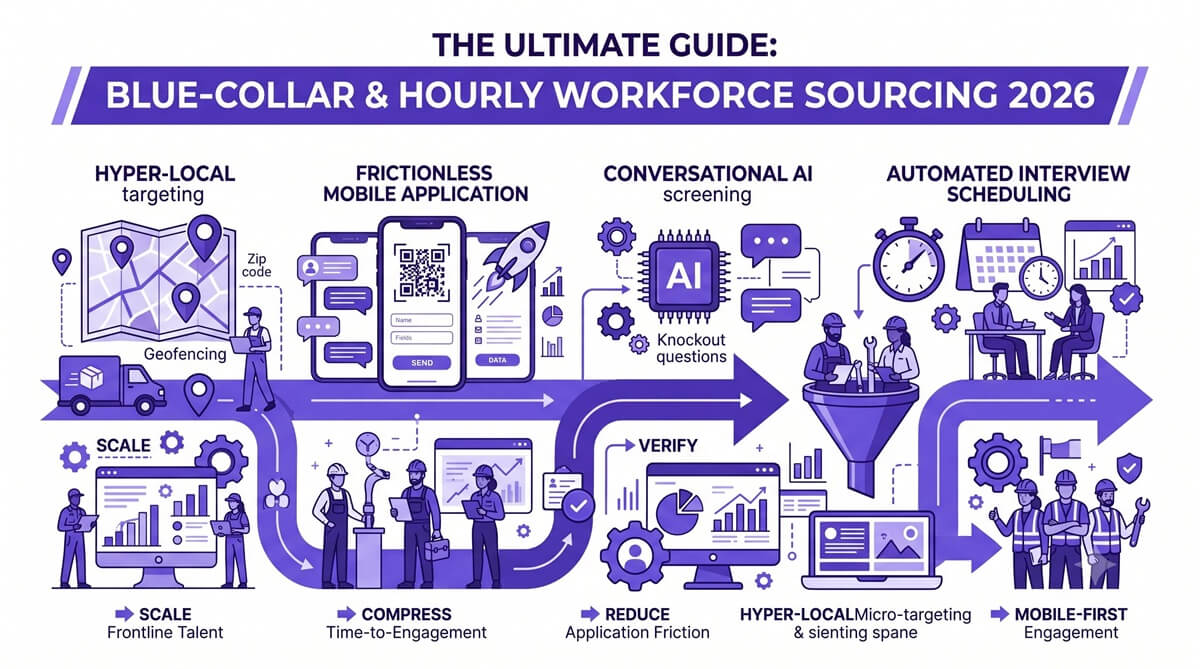
Optimizing your hourly sourcing framework for 2026 requires a radical shift from white-collar recruiting methodologies. To scale your industrial footprint, your talent acquisition (TA) engine must adapt to hyper-local micro-targeting, mobile-first conversational automation, and instant, qualified engagement. This guide delivers the tactical playbook to building a high-velocity frontline sourcing engine.
1. Hyper-Local Sourcing & The “5-Mile Radius” Reality
Enterprise sourcing teams often treat hourly recruiting like corporate recruiting, running massive geographic campaigns across entire metropolitan statistical areas (MSAs). This strategy ignores the fundamental geography of the hourly worker.
The Proximity Rule: Data reveals that more than 80% of hourly employees work within a 5-mile radius of their home.
For the hourly workforce, commuting distance is directly tied to job profitability. If an employee spends an hour of their daily wage on fuel or public transit to travel 20 miles, the position loses its financial viability. Therefore, your digital ad dollars must be targeted with geographic precision.
Implementing Hyper-Local Sourcing:
- Geofenced Programmatic Bidding: Program your job advertising platforms to target mobile devices within exact zip codes or narrow mile radiuses surrounding your distribution center, retail outlet, or job site.
- Localized Social Communities: Shift focus to hyper-local channels like geo-targeted Facebook Groups, Nextdoor, and localized digital boards. Workers actively leverage their personal neighborhoods to find close-to-home opportunities.
- Physical-to-Digital Intercepts: Utilize high-visibility QR codes placed on corporate fleet vehicles, delivery packaging, and physical building signage. A simple physical intercept that opens an instant mobile application converts passive, local observers at an infinitely higher rate than online search queries.
2. Frictionless, Mobile-First Application Paths
Hourly workers frequently apply for jobs while on the move, between shifts, or entirely via mobile devices. Statistics show that over 58% of hourly candidates use mobile phones to complete applications.
Every added field, document requirement, or external redirect acts as a barrier that drops your conversion rate significantly. Reducing your online application completion time by just 10% translates to an immediate 2.3% increase in mobile applicant conversion.
The Frictionless Playbook:
- Eliminate the Mandatory Resume: For entry-level logistics, production, and retail roles, standard resumes are completely obsolete. Replace them with highly structured, mobile-friendly forms that ask only for contact info and basic shift availability.
- Conversational Chat Apply: Allow candidates to apply entirely through messaging channels like automated text message (SMS) or WhatsApp workflows. An automated screening assistant can prompt the applicant text-by-text, gathering essential data organically.
- Basic Knockout Frameworks: Filter candidates at the top of the funnel using immediate minimum qualification questionnaires. Ask simple binary questions: Are you certified to operate a forklift? Can you work weekend shifts? Do you possess a valid commercial driver’s license (CDL)? If yes, they immediately advance; if no, they are gently redirected.
3. Compressing Time-to-Engagement to Less Than 24 Hours
In the hourly sector, the fast employer wins. Hourly job seekers are rarely exclusive; they apply to multiple opportunities concurrently and prioritize the organization that acknowledges their existence first.
Reaching out to an applicant within 24 hours increases their likelihood of proceeding to an interview by 52%. If you wait 48 to 72 hours, the candidate has likely checked out and moved on.
Engineering Real-Time Velocity:
- Instant Automated Text Scheduling: The moment an applicant passes your basic online knockout questions, your automated engine should instantly text them a calendar link. Allow the candidate to self-schedule an phone screen or in-person open interview within the upcoming 48 hours, removing manual coordinator delays entirely.
- Continuous Batch Recruiting: Rather than managing separate reqs for individual hourly openings, maintain open, evergreen pool pipelines. Shift your recruiters’ focus from manual tracking to running structured, weekly group hiring sessions or daily open-door walk-in hours.
4. The 2026 Blue-Collar Value Proposition: Scheduling, Upskilling, and Transparency
Sourcing hourly talent successfully in 2026 demands absolute clarity in your employment marketing messaging. The new generation entering the skilled trades and manufacturing sectors places an immense premium on lifestyle balance, respect for their personal time, and professional progression.
To capture high-quality applicants over competing local employers, ensure your sourcing copy features these three pillars prominently:
Transparent Pay and Work Environment
Do not conceal compensation behind phrases like “competitive market wages.” Modern job postings must explicitly state the exact hourly wage, mandatory vs. voluntary overtime parameters, shift premiums, and precise tool or uniform allowances up front.
Schedule Predictability
The modern workforce actively rejects unexpected, last-minute on-call shifts. Sourcing ads that highlight structured, fixed schedules, compressed workweeks (such as four 10-hour days), or modern swap-shift flexibilities will consistently outperform standard job descriptions.
Apprenticeships and Upskilling Pathways
With the skilled trades talent pool continuously tightening, top-performing enterprises are shifting away from chasing the “perfectly experienced” technician. Instead, they lead their recruitment messaging with structured career advancement pathways.
Highlighting paid vocational training, official apprentice programs, and internal licensing tracks serves as a highly effective mechanism to attract long-term, growth-minded applicants.
5. The Hourly Sourcing Channels Matrix 2026
To maximize the efficiency of your operational spend, segment your talent sourcing efforts across targeted media funnels:
| Sourcing Channel | Target Demographics | Primary Operational Advantage | Key Best Practice |
| Trade-Specific Boards (e.g., Road Dog Labs, Blue Collar Recruits) | Specialized Skilled Trades (Electricians, Welders, Journeyman Plumbers) | Attracts active, credentialed specialists who bypass general job search sites. | Feature clear credential requirements and equipment provisions in the headline. |
| Local Community Networks (e.g., Facebook Groups, Nextdoor) | Entry-Level Logistics, Material Handlers, Local Retail Associates | Hyper-local reach; connects directly with candidates within a 5-mile radius. | Keep postings highly informal, responsive, and conversational. |
| Internal Employee Referral Networks | Cross-Industry Hourly Staff (Production, Warehouse Operators) | Delivers the highest retention rates and lowest total cost-per-hire. | Utilize automated SMS systems to payout rapid referral bonuses directly via digital cards. |
| Vocational & Trade School Partnerships | Apprentices, HVAC Techs, Early-Career Assemblers | Builds a sustainable, long-term pipeline of fresh, highly motivated talent. | Sponsor local lab equipment or offer paid internship programs prior to graduation. |
6. Verifying Credentials and Navigating AI Fraud
As talent acquisition teams lean heavily into automated, mobile-first sourcing, a unique operational risk has emerged: digital candidate fraud. With the widespread availability of consumer generative AI tools, the volume of automated applications, inflated digital resumes, and exaggerated skill credentials has risen significantly.
In hands-on blue-collar roles, safety compliance, physical coordination, and verified field experience are completely non-negotiable.
Securing Your Sourcing Pipeline:
- Immediate Professional License Verification: If a role demands specific safety or trade credentials (such as an OSHA 30 certification, EPA Universal card, or a Class A CDL), embed an automated license validation check into the initial screening stage. Use programmatic verification software to cross-reference state databases before scheduling an interview.
- Practical Behavioral Audits: Because written profiles can be easily enhanced by AI, shift your evaluation process toward live, practical problem-solving. Ask candidates to verbally diagnose an equipment malfunction or explain a specific field safety procedure during the initial phone screen to evaluate true operational fluency.
Conclusion: Velocity is Your Competitive Edge
Sourcing the blue-collar and hourly workforce in 2026 is an exercise in operational agility. The organizations winning the frontline talent race are not those writing the longest job descriptions or spending blindly on untargeted national networks.
Success belongs to the TA teams that design hyper-local sourcing paths, eliminate application friction, and leverage fast automation to engage candidates in real time. By converting your recruitment strategy into a localized, rapid-response mechanism, you build a resilient pipeline of essential talent designed to keep your operations moving forward.