
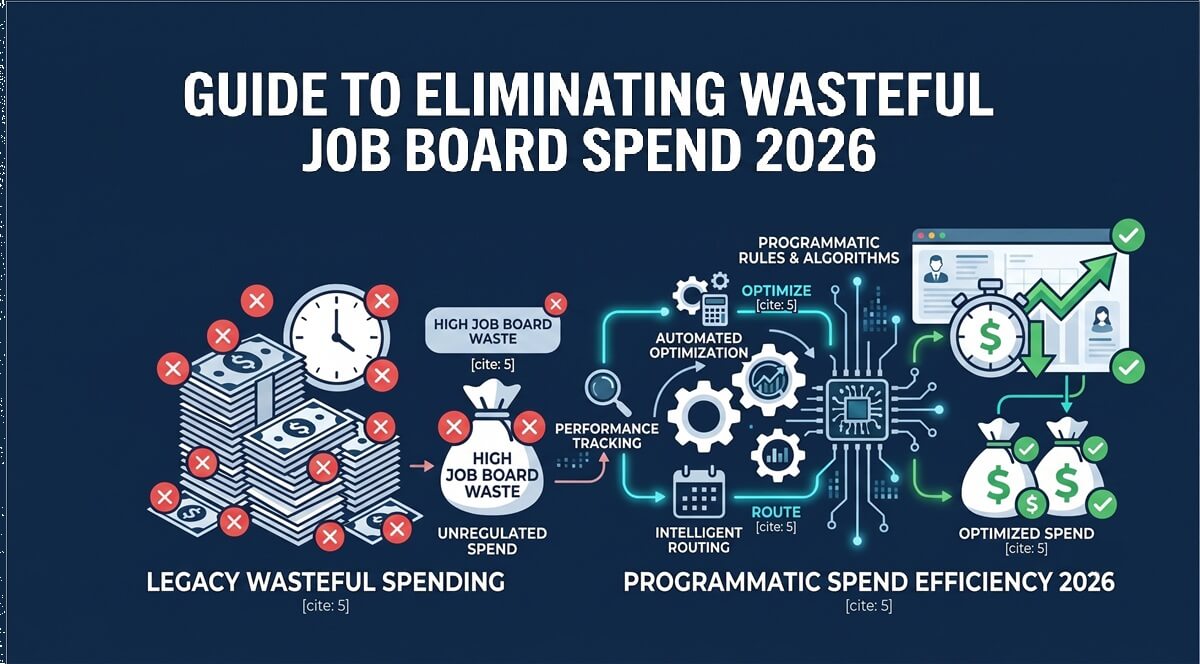
If you are leading an enterprise Talent Acquisition (TA) team in 2026, you are likely facing a frustrating paradox. On one hand, you have specific, high-priority, “hard-to-fill” technical or specialized roles that sit open for months, starving business units of critical capacity. On the other hand, your retail, customer success, or entry-level roles get flooded with hundreds of single-click applications within 48 hours of posting.
The real tragedy? Both scenarios are draining your recruitment budget simultaneously.
Legacy job marketing strategies operate on a flat-rate or uncapped Cost-Per-Click (CPC) model. Without strict guardrails, popular, easy-to-fill roles act as budget vampires—devouring your recruitment ad spend long after you have received more than enough qualified resumes. Meanwhile, your high-scarcity, hard-to-fill requisitions are left penniless, buried on page ten of the job boards.
It’s time to break this cycle. This guide outlines how modern TA teams are utilizing algorithmic programmatic caps to instantly eliminate wasteful job board spends and dynamically route budget where it actually generates a return on investment (ROI).
1. The Anatomy of the “Easy-to-Fill” Role Trap
To fix your job ad spend, you first have to understand where the money leaks out. When you purchase traditional duration-based job postings or run uncapped programmatic campaigns, you pay uniformly for exposure.
Consider this standard scenario:
- Role A (Easy-to-Fill): An entry-level Account Executive or remote Operations Coordinator.
- Role B (Hard-to-Fill): A Senior Cloud Security Architect or a specialized Lead Nurse Practitioner.
Because Role A has a massive target demographic, job board algorithms naturally prioritize it. It gets clicks, engagement, and applications. If your campaign is uncapped, the job board will happily keep serving that ad, collecting clicks, and charging your account.
Within a week, you’ve spent $1,500 on Role A and collected 400 applications. Your recruiters can realistically only screen 40 of them. The remaining 360 applicants represent pure financial waste and a massive burden on your screening pipeline.
Meanwhile, Role B has spent only $50 because it generates fewer clicks. It remains completely starved for visibility. Your overall budget is gone, your easy role is over-indexed, and your hard role is still vacant.
2. What are Programmatic Ad Caps?
Programmatic ad caps are automated rules that systematically restrict how much money, how many clicks, or how many applications a single job listing can accumulate before the system pauses its distribution.
Instead of a human recruiter manually checking the Applicant Tracking System (ATS) every morning and logging into multiple job boards to turn off ads, an intelligent system manages this in real-time.
The Core Rule of 2026 TA Spend: Every job posting must have a definitive ‘Success Ceiling.’ The moment an ad achieves its target objective, it must immediately stop consuming corporate capital.
There are three primary types of programmatic caps you should deploy across your recruitment ecosystem:
- Application Volume Caps: Pauses the ad automatically the exact moment a job listing reaches a specific number of total applications (e.g., shut off the ad at 50 applicants).
- Quality/Status Caps: Pauses the ad based on downstream metrics inside your ATS, such as reaching 10 candidates who have been marked as ‘Screen Passed’ or ‘Hiring Manager Interview Scheduled’.
- Financial Caps: Sets hard daily or lifetime budget boundaries per requisition, ensuring no single high-volume role can monopolize more than its designated percentage of the monthly allocation.
3. The Power of Dynamic Budget Redistribution
Setting a cap is only half the battle. The true magic happens when your sourcing platform seamlessly executes multi-channel routing.
When a programmatic cap triggers and pauses an easy-to-fill role, that unspent budget doesn’t just sit idle. The programmatic engine instantly calculates which of your open, hard-to-fill roles are under-indexed and automatically redirects those dollars toward them.
By shifting funds from a role that has reached its ‘Success Ceiling’ to a high-scarcity role, you essentially finance your hardest hires using the money you used to waste on over-indexing easy ones. You increase the total yield of your recruitment budget without asking finance for a single extra dollar.
4. Bridging the Gap: Connecting Caps to Your ATS
To build an air-tight programmatic capping strategy, your marketing engine cannot rely on top-of-funnel clicks alone. A click does not guarantee a qualified candidate. If your system caps an ad because it got 100 clicks, but 95 of those clicks abandoned the application process mid-way, your cap has fired too early, leaving the role unfilled.
This requires a closed-loop integration between your job distribution platform (like Sourcing Square) and your core enterprise ATS (Workday, iCIMS, Greenhouse, etc.).
When a candidate applies and hits your ATS, a secure webhook sends a real-time signal back to the programmatic engine. The system evaluates the candidate’s status: Did they complete the application? Did they pass the basic knock-out screening questions? Are they qualified?
By capping ads based on Cost-Per-Qualified-Candidate (CPQC) rather than raw traffic, your budget automation is steered by actual pipeline health, maximizing quality while ruthlessly cutting out top-of-funnel noise.
5. The Enterprise Implementation Matrix
| Requisition Tier | Examples | Traffic Tendency | Recommended Programmatic Cap Strategy |
| Tier 1: High Velocity (Easy-to-Fill) |
Customer Support, Entry Sales, General Operations | Extremely High; fast application accumulation. | Strict Application Cap: Set a maximum ceiling of 40–50 total applications. Implement aggressive daily financial sandboxes ($10/day max) to prevent immediate budget exhaustion. |
| Tier 2: Steady Growth (Medium Difficulty) |
Mid-level Engineers, Field Marketing, Account Managers | Moderate; predictable conversion rates. | Closed-Loop Status Cap: Cap the ad spend only when 5 candidates successfully advance to the ‘Hiring Manager Review’ stage in the ATS. |
| Tier 3: Niche Scarcity (Hard-to-Fill) |
Enterprise Security Architects, Specialized Clinicians, Executive Roles | Low volume; high target pass-rates required. | No Application Cap: Remove volume restrictions. Set up automated Aggressive Bid Routing so any funds saved from Tier 1 caps are automatically funneled here to boost premium placement. |
6. The Bottom-Line Impact: A 2026 Case Study Blueprint
What does this look like in practice? Consider an enterprise organization managing 500 open roles concurrently.
Under a legacy system, approximately 70% of their ad spend organically flows to their easiest 150 roles, simply because those roles convert faster and drive up programmatic click costs. They end up over-paying for talent they would have attracted anyway, while their 50 most critical technical vacancies remain unfilled, stalling corporate product timelines.
By deploying automated programmatic caps:
- The organization locks down spend on those 150 easy roles the moment optimal pipelines are built.
- They capture an average savings of 35% to 45% on legacy job board spend.
- That saved capital is algorithmically injected into premium visibility contracts, targeted aggregators, and niche networks for their hard-to-fill vacancies.
- The Result: Time-to-fill for critical, hard positions drops by weeks, cost-per-hire plummets across the board, and recruiters spend zero hours sorting through irrelevant, over-capped application backlogs.
Conclusion: Take Control of Your Media Buying
Relying on job boards to self-regulate how much of your budget they consume is a losing strategy. They are incentivized to sell you volume. As a Talent Acquisition leader, your mandate is to buy outcomes.
By embedding automated programmatic caps and intelligent routing into your 2026 sourcing strategy, you take control of your talent ecosystem. You protect your budget from high-volume drains, optimize your team’s valuable screening hours, and build a predictable, automated pipeline that feeds every corner of your business with precision.