
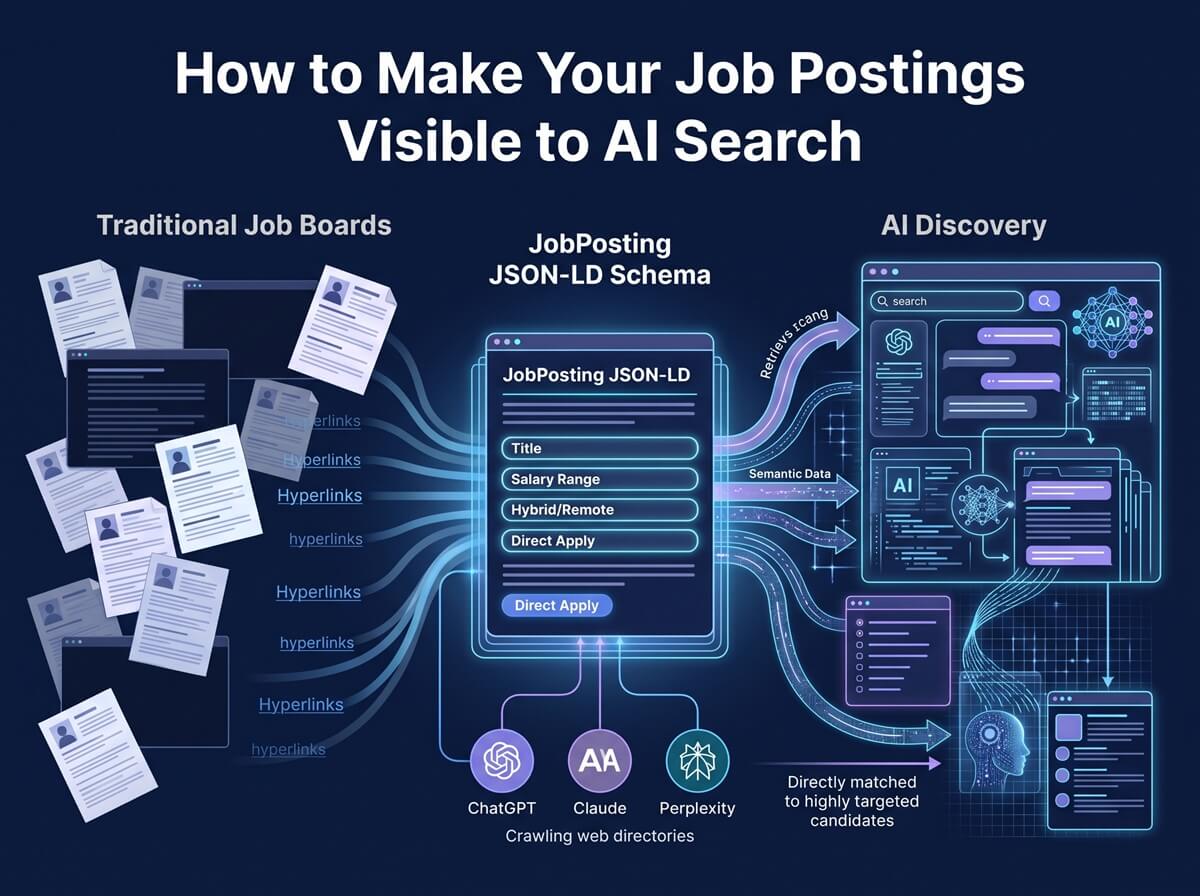
Candidate search behavior has changed more dramatically than it did when online job boards launched thirty years ago. High-intent professionals are no longer wading through hundreds of keyword-stuffed search results on legacy employment portals. Instead, they are pasting their resumes, target salaries, preferred tech stacks, and commute tolerances directly into conversational AI engines like ChatGPT, Claude, and Perplexity.
These candidates ask precise, complex questions: “Which B2B SaaS companies in Chicago are hiring Senior Backend Engineers with Go experience and offering hybrid schedules?”
When an AI engine processes that request, it does not display ten blue links. It evaluates real-time indexed data, synthesizes the requirements, and recommends specific open roles with direct citations. If your organization’s career portal and job listings are not built for machine readability, your open requisitions are invisible to the fastest-growing candidate search channel in the world.
Winning this new talent acquisition frontier requires Generative Engine Optimization (GEO) for recruitment. This technical guide details how to audit, structure, and syndicate your job postings so AI search engines can crawl, understand, and recommend your career opportunities.
Why Traditional Career Sites Are Invisible to AI Crawlers
Most enterprise career portals were engineered for human web browsers navigating desktop screens, not autonomous AI crawlers extracting discrete entities. This architectural gap causes millions of open jobs to be passed over every day. Four technical roadblocks explain why AI engines fail to surface standard job listings:
1. The iframe Blind Spot
A significant number of Applicant Tracking Systems (ATS) embed open jobs onto corporate career pages using <iframe> containers. While human visitors see a seamless grid of open positions, web scrapers and AI retrieval bots generally see an empty frame. The bot extracts zero semantic text, resulting in zero indexable positions.
2. Client-Side JavaScript Hydration
Modern web frameworks (such as React, Angular, and Vue) frequently render job details on the client side after the initial HTML payload has loaded. Many specialized AI search crawlers do not execute heavy, resource-intensive JavaScript scripts; they scrape raw server-side HTML. If your job description only appears after a browser executes multiple API calls, search agents log an empty page.
3. Misconfigured Firewall and Bot Management Rules
Enterprise security solutions like Cloudflare, Akamai, or custom Web Application Firewalls (WAFs) are routinely tuned to block automated traffic. Without deliberate whitelisting, these security layers frequently lump legitimate AI search crawlers (like OpenAI’s OAI-SearchBot) into the same category as malicious scraping bots, instantly serving them a 403 Forbidden challenge.
4. Vague, Unstructured Job Copy
Traditional job descriptions are notoriously filled with corporate idioms: “rockstar problem solvers,” “dynamic team player,” or vague team summaries with zero explicit salary ranges. AI models thrive on structured facts, entity relationships, and transparent parameters. Postings that omit fundamental metadata—such as pay brackets, explicit office requirements, and verifiable tech requirements—rank poorly in LLM retrieval benchmarks.
Configuring Crawlers in Robots.txt
AI engines run distinct bots for training large language models versus retrieving live web data for user search queries. While your organization may have corporate policies restricting web crawlers from training on proprietary documentation, recruitment content is public marketing collateral where total discoverability is the primary goal.
To allow prospective candidates to discover your positions through AI queries, you must explicitly permit search-oriented bots inside your robots.txt configuration:
Allow AI search retrieval agents to index open job requisitions
User-agent: OAI-SearchBot
Allow: /careers/
Allow: /jobs/
User-agent: Claude-SearchBot
Allow: /careers/
Allow: /jobs/
User-agent: PerplexityBot
Allow: /careers/
Allow: /jobs/
User-agent: Google-Extended
Allow: /careers/
Allow: /jobs/
OAI-SearchBot: Powers live web search results and source citations inside ChatGPT.
Claude-SearchBot: Serves search grounding for Anthropic’s Claude assistant.
PerplexityBot: Indexes web pages to generate immediate, cited answer cards in Perplexity AI.
Google-Extended: Controls how Google uses your content within Gemini and AI Overviews.
Ensure your DevOps and IT infrastructure teams verify that edge-layer security firewalls do not block these specific User-Agent headers.
Implementing Structured JobPosting Schema (JSON-LD)
To eliminate ambiguity about your requisitions, embed job details directly on each page using Schema.org’s JobPosting vocabulary in JSON-LD format.
JSON-LD (JavaScript Object Notation for Linked Data) provides search models with standardized, machine-readable facts: job title, compensation, employment type, location, and application protocols. Instead of forcing an LLM to guess what your salary or remote work policy is, schema delivers unambiguous facts.
High-Impact Schema Fields for AI Retrieval:
- baseSalary & currency: Candidates routinely use compensation as a strict filter when prompting AI models. Postings that omit structured pay data are frequently eliminated by the LLM before candidate review.
- jobLocationType (TELECOMMUTE): AI agents instantly flag this property when candidates request remote or distributed work opportunities.
- validThrough: Prevents AI engines from recommending expired postings, protecting employer brand credibility.
- directApply: Informs retrieval systems that candidates can apply directly on that URL without navigating third-party landing pages or deceptive paywalls.
Writing Job Descriptions for Semantic Answer Engines
Beyond underlying code, the on-page copy of your job description must cater to conversational extraction. When an LLM scans a page to formulate an answer, it selects concise, self-contained paragraphs that directly address user questions.
Adopt these writing standards across every published requisition:
- Lead with an Atomic Summary: Begin the job posting with a concise 2-to-3 sentence summary that clearly states the core mission, seniority, department, tech stack, and primary reporting line. AI algorithms disproportionately extract opening statements to synthesize prompt summaries.
- Replace Clever Headings with Concrete Questions: Instead of styling headers with buzzwords like “What You Bring”, use direct phrasing such as “Required Technical Skills and Tooling” or “What Experience Do You Need for This Role?”
- Itemize Must-Haves as Bulleted Entities: Explicitly state programming languages, enterprise certifications, and operational workflows in clean bullet points. LLM parsers extract categorical lists far more accurately than narrative prose.
- Incorporate an On-Page Hiring FAQ: Add a short question-and-answer section answering practical logistics: What does the interview process look like?, What are the standard working hours?, and Are visas supported? These exact questions are what candidates type into search prompts.
The Danger of Stale Postings and Hallucinated Roles
A major obstacle facing AI-driven job discovery is data decay. Traditional web indexing can take days or weeks to register that a requisition has been closed. If an AI assistant recommends a role that was filled two weeks prior, the candidate encounters an expired link or 404 page, creating a negative candidate experience and wasting recruitment touchpoints.
Furthermore, modern AI models penalize domains that consistently serve broken links and inactive listings.
To preserve domain trust:
- Automate Status Codes: The moment an ATS marks a requisition as filled or paused, the public URL should return clear, machine-readable indicators rather than leaving an orphan landing page.
- Dynamically Update Expiration Timestamps: Maintain real-time sync between your core database and the validThrough schema attribute.
- Deploy Programmatic Feeds: Static XML feeds updated once a week are obsolete. Real-time programmatic syndication ensures that job board partners, search bots, and talent networks instantly register changes in requisition status.
Programmatic Delivery: The Foundation for AI-First Sourcing
Optimizing a single job description on your website is straightforward; maintaining synchronized, machine-readable postings across hundreds of open requisitions is an enterprise challenge. This is where programmatic recruitment advertising forms the crucial backbone of modern talent operations. While manual job boards lock you into static 30-day postings that quickly grow stale and invisible, programmatic job distribution continuously synchronizes your active ATS requisitions with dozens of high-traffic publisher networks and niche search channels.
Through platforms like Sourcing Square, talent acquisition teams pair search discoverability with intelligent automated budget pacing:
- Real-Time Requisition Sync: Your active job listings remain updated, accurate, and completely crawlable across search ecosystems.
- Automated Budget Pacing: Avoid burning spend on roles that have already reached their candidate quota. The moment target application caps are reached, distribution pauses automatically.
- Dynamic Budget Reallocation: Surplus ad spend is instantly shifted to boost visibility on hard-to-fill, niche positions that need greater reach across specialized talent networks.
When you combine clean, LLM-optimized career architecture with automated programmatic distribution, you create a hiring engine that surfaces your open roles to top candidates, wherever they choose to search.