
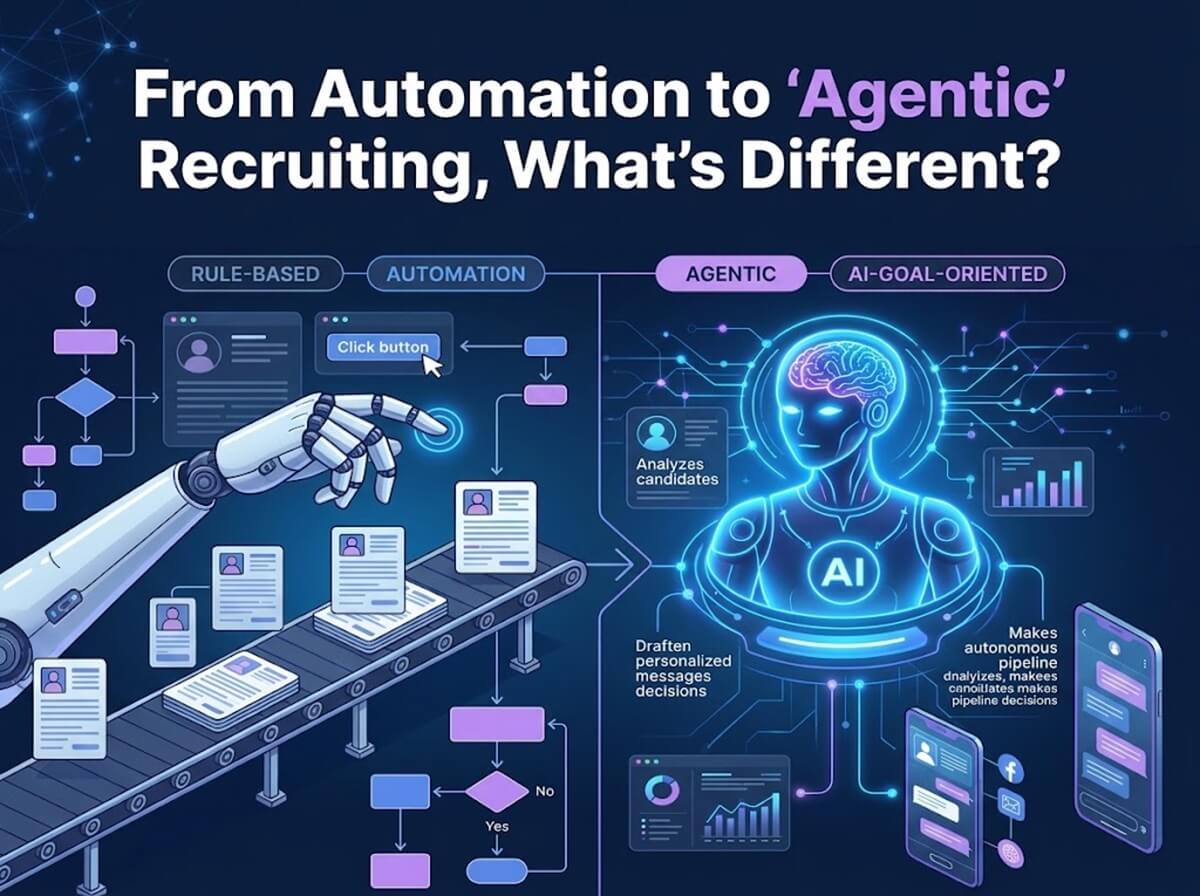
The landscape of enterprise talent acquisition has fundamentally transformed. Over 93% of Fortune 500 companies now use artificial intelligence in some part of their hiring process. Yet, despite this widespread adoption, many talent leaders conflate basic recruitment automation with true AI capability.
For years, HR technology has relied on rigid, rule-based automation to clear administrative backlogs. While this eliminated significant manual data entry, it never possessed the capacity to evaluate talent, write personalized outreach, or adapt to changing circumstances. Today, the recruitment industry is experiencing a profound shift away from static automation and toward “agentic” recruiting.
According to Deloitte’s 2025 Global Human Capital Trends report, agentic AI is one of the highest-impact changes currently underway in human resources. But what exactly separates standard automation from agentic recruiting workflows?
This comprehensive guide breaks down the core differences, the impact on enterprise hiring metrics, and how autonomous agents are permanently altering the talent acquisition funnel.
The Era of Recruitment Automation: The “If-Then” Framework
To understand where recruitment is going, we must define where it currently stands. Recruitment automation is the execution of predefined workflows without manual intervention. It serves as the digital plumbing of a hiring process, ensuring data flows correctly between systems and that administrative bottlenecks are mitigated.
Automation operates strictly on human-configured “if-then” logic. A recruiter or systems administrator sets a trigger, defines a condition, and dictates the subsequent action.
Common examples of traditional recruitment automation include:
- Pipeline Stage Transitions: Automatically moving a candidate to a new workflow stage in the Applicant Tracking System (ATS) based on a specific trigger, such as passing a phone screen.
- Job Posting Distribution: Automatically pushing a newly opened requisition to dozens of job boards and managing the posting duration without analyzing performance.
- Status Notifications: Sending out templated rejection emails or notifying hiring managers when a requisition has been open for more than 30 days.
- Basic Scheduling: Sending a candidate a static calendar link to select a time slot for a screening call.
- Compliance Tracking: Consistently capturing Equal Employment Opportunity (EEO) data and maintaining reliable audit trails for compliance purposes.
Automation handles the repetitive, rule-based portions of talent acquisition beautifully, but it has a hard operational ceiling. Automation cannot evaluate whether a candidate is actually a good fit for a role. It cannot analyze a candidate’s specific background to write a customized outreach message. It executes perfectly, but it possesses zero judgment.
Enter Agentic Recruiting: Goal-Oriented AI Workflows
Agentic hiring represents a massive paradigm shift. While standard automation executes a single rule, an AI agent pursues a specific goal across multiple steps independently.
Agentic recruiting systems utilize Large Language Models (LLMs) trained on vast datasets to interpret complex requests, determine the most appropriate sequence of actions, and execute those actions through connected software tools. Instead of waiting for a human to prompt each individual task, an agent can manage an end-to-end workflow.
For example, an AI agent can independently find candidates, draft highly personalized outreach messages, monitor their replies, coordinate screening calls, and update the ATS system—all before a human recruiter needs to step in.
The 5 Core Differences Between Automation and Agentic AI
The divide between these two technologies becomes clear when examining how they handle daily recruitment functions. Here are the five key differences.
1. Execution vs. Decision-Making
- Automation: Executes predefined rules blindly. If a candidate applies, they receive an automated confirmation email.
- Agentic AI: Evaluates situations and makes contextual decisions based on data. It can look at an incoming application, read the resume, and determine if the candidate possesses the required skills for the role.
2. Keyword Filters vs. Semantic Screening
- Automation: Automated resume screening relies on rigid keyword matching. If a job requires “5+ years of machine learning experience,” the automation simply scans the document for the exact phrase “machine learning” and a number equal to or greater than five.
- Agentic AI: Agentic screening evaluates context. An agent reads a resume and a job description together. It can deduce that a candidate who “developed predictive models for supply chain optimization” possesses deep machine learning expertise, even if the exact keyword is missing from their profile. Crucially, agents produce a ranked shortlist with clear reasoning attached, providing an audit trail for the hiring decision.
3. Static Templates vs. Deep Personalization
- Automation: Outreach automation inserts basic data variables into static templates (e.g., Hello {first_name}, I saw you work at {company}).
- Agentic AI: The personalization agent analyzes a candidate’s career history, specific skills, and past engagement signals to generate highly tailored messaging at scale. It writes messages that reference actual career trajectories, adjusting tone and content based on candidate behavior. The result is a significant increase in response rates, as candidates recognize genuine understanding rather than a generic template.
4. Rigid Coordination vs. Navigating Ambiguity
- Automation: Uses tools like Calendly to offer static availability slots. If a conflict arises, the human coordinator must step back in.
- Agentic AI: The scheduling agent handles the inherent ambiguity of interview coordination. It manages multi-party calendar scheduling across different time zones, intelligently handles back-and-forth email negotiations, and seamlessly executes rescheduling requests without human intervention.
5. Static Outcomes vs. Reinforcement Learning
- Automation: Automated systems produce the exact same outcome on day 100 as they did on day 1. They remain entirely static until a human manually changes the backend rules.
- Agentic AI: Agentic workflows improve continuously through Reinforcement Learning from Human Feedback (RLHF). Every time a hiring manager reviews a sourced candidate and provides feedback, the agent adjusts its matching criteria. The tenth batch of candidates presented to the hiring manager will be noticeably better and more aligned than the first.
How Agentic AI Rebuilds the Talent Funnel
The implementation of agentic AI is not about buying one overarching software tool; it is about deploying specialized agents across the most data-rich, repeatable stages of the talent funnel.
The Intake and Sourcing Agent
Recruiters historically spend hours manually scanning internal talent pools and external networks. The Sourcing Agent continuously scans these databases against open role requirements, automatically identifying and scoring candidates on fit. Because sourcing is high-volume and low-judgment work, deploying agents here yields immediate labor savings. It turns sourcing from a reactive, time-boxed task into a continuous engine. Furthermore, Intake Agents can conduct structured, asynchronous conversations with hiring managers to immediately surface internal candidates and generate optimized job descriptions, shrinking intake cycles from days to hours.