
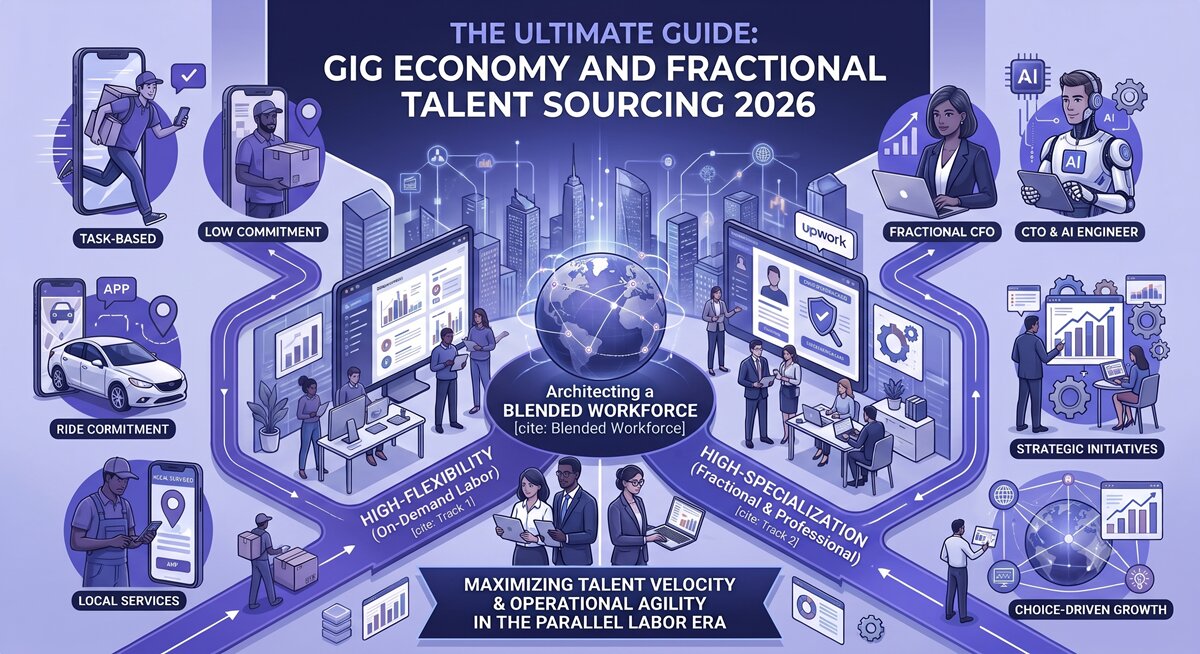
For decades, the standard organizational chart was rigid, filled with boxes representing full-time, 40-hour-a-week W-2 employees. But in 2026, the corporate paradigm has permanently fractured. The “gig economy” has matured far past its origins of ride-sharing and entry-level food delivery. Today, it functions as a highly sophisticated, parallel labor system operating alongside traditional employment, fueled by a massive influx of high-earning, high-skill independent professionals.
This evolution has birthed the Blended Workforce—a strategic operational framework where enterprises seamlessly integrate core full-time staff, specialized project-based contractors, and high-level fractional experts.
For Talent Acquisition (TA) leaders in 2026, managing this shift isn’t just about outsourcing occasional tasks; it requires a deliberate strategy built around modern contingent workforce management, compliance, and global talent pipelines. This guide provides the blueprint to mastering this modern frontier.
1. Decoding the 2026 Gig Ecosystem: Track 1 vs. Track 2
To build an effective sourcing engine, you must understand that the modern independent labor market moves along two concurrent track:
- Track 1: High-Flexibility On-Demand Labor: This refers to the traditional segment of the gig economy—supplemental income, lower commitments, and task-oriented outputs. Workers in this bracket typically use platform-mediated, consumer-facing apps for local services and heavily prioritize control over their personal schedules.
- Track 2: High-Specialization Independent & Fractional Experts: This is the fastest-growing and highest-earning segment of the gig economy. Millions of professionals—ranging from software architects and cybersecurity consultants to fractional CFOs—have intentionally rejected single-employer corporate paths in favor of running highly specialized portfolio careers.
The Choice-Driven Workforce: In 2026, independent work is no longer the default option for those who “cannot find a job”. Over 50% of younger professionals actively choose freelancing because it grants direct agency over their skill acquisition, professional growth, and lifestyle.
2. The Rise of the Fractional Executive (C-Suite on Tap)
Startups and mid-market enterprises frequently find themselves in a catch-22: they desperately need elite leadership to guide them through major growth milestones, yet they lack the capital to support the full-time, million-dollar compensation packages required to land a seasoned C-suite executive.
This is where fractional talent sourcing has become an operational necessity.
A fractional executive is a veteran professional—such as a CFO, CMO, or Chief Information Security Officer (CISO)—who integrates into your business on a part-time, retainer, or percentage-of-time basis. Instead of working for one company full-time, they apply their deep industry experience across three or four non-competing clients simultaneously.
Why Enterprises Lean on Fractional Leaders:
- Cost-Efficient Authority: You gain immediate, veteran guidance at a fraction of the cost of a full-time, long-term hire.
- Rapid Time-to-Value: Fractional leaders bypass the standard 90-day ramp-up phase. They are paid to execute specific, predefined strategic initiatives from day one.
- Immediate Expertise Injection: Whether navigating an M&A transition, rolling out an enterprise generative AI infrastructure, or modernizing a supply chain, fractional experts provide specialized knowledge that is rarely needed permanently.
3. Where to Source High-Value Fractional and Gig Talent in 2026
The sourcing channels for specialized independent talent look vastly different than standard full-time recruitment networks. In 2026, highly curated platforms have arisen to match businesses with top-tier fractional and gig experts:
| Platform Name | Specialization / Focus | Pricing & Delivery Model | Best Suited For |
| GoFractional | Premium C-suite, tech, and marketing leaders. | Ongoing markup model (typically 20% on top of billing). Handles legal, paperwork, and invoicing. | Large enterprises requiring managed vendor services. |
| Fractional Jobs | General executive roles (marketing, finance, product). | Direct matchmaking with a one-time referral fee. No ongoing platform markup. | Startups and mid-market firms looking to own candidate relationships directly. |
| Shiny | Highly seasoned startups and SMB C-level leaders. | Lower ongoing platform markup (typically 10%), with no upfront search fees. | Fast-growing, early-stage companies wanting a low-barrier executive match. |
| Bolster | Vetted startup leadership (especially tech, finance, and operations). | Rigorous, personalized matchmaking curated for growth-stage businesses. | Venture-backed and high-growth organizations. |
| Expert360 | Elite APAC-centered enterprise executive and project talent. | Direct consulting match with localized compliance infrastructure. | Multinational organizations operating in Australia, New Zealand, and Asia-Pacific regions. |
4. Navigating the 2026 Regulatory Minefield
While a blended workforce offers unparalleled agility, it also brings strict regulatory scrutiny. Governments worldwide are actively rewriting employment classification boundaries to prevent misclassification. Accidentally classifying an employee as an independent contractor can trigger severe financial penalties, retroactive taxes, and class-action lawsuits.
Three massive regulatory shifts are currently active:
- The EU Platform Work Directive: Passing its final transposition deadlines, this directive establishes a legal presumption of employment for gig and platform workers across Europe.
- The UK Border Security, Asylum and Immigration Act: Mandates rigorous “Right to Work” verification checks for casual, gig, and zero-hours workers.
- US Classification Guidelines: Active audits from the Department of Labor and the IRS strictly enforce behavioral and financial control standards.
The Litmus Test of Classification: Always ask: Do you control how and when the work is done, or are you simply paying for a specified end result? If your organization dictates working hours, enforces the use of corporate-issued laptops, or makes the contractor perform tasks central to your core daily business offerings, they should likely be classified under a W-2 model.
5. Screening & Verifying in the Age of AI Fraud
Sourcing fractional and gig talent online comes with unique digital threats in 2026. With the explosion of generative AI, HR analysts warn that a growing percentage of online applicant profiles, tech portfolios, and reference records are partially or completely fabricated.
Gig and contract-matching networks are primary targets for identity theft and resume spoofing due to their speed and fully remote nature.
To insulate your pipeline from fraudulent actors, upgrade your screening protocols:
- Transition to Digital ID Verification: Rather than relying on static PDF document uploads, utilize modern digital identity wallets (such as Europe’s eIDAS 2.0 structure) to verify a freelancer’s actual, government-backed identity.
- Verify Past Project Portfolios, Not Resumes: Highly skilled independent workers live and die by their actual work samples. Do not rely on listed credentials; instead, evaluate verifiable GitHub repositories, live software builds, or historical business case studies.
- Mandate Live, Interactive Technical Audits: Use real-time collaborative whiteboards or live scenario-based problem-solving during your screening calls. An AI can write a brilliant resume, but it cannot mimic authentic, conversational expertise under pressure.
6. Actionable Sourcing Checklist for Enterprise Leaders
To effectively operationalize gig and fractional sourcing, your talent acquisition department must drop standard full-time recruitment behaviors. Implement this operational checklist to start capturing talent:
- Draft Deliverable-Focused Descriptions: Scrap the paragraphs about office culture and team retreats. Lead your postings with the exact project scope, technical requirements, target budget, and estimated hours per week.
- Accelerate Your Onboarding Speed: Top-tier independent workers are in high demand and handle multiple client inquiries simultaneously. Ensure your legal templates, NDAs, and contractor master services agreements (MSAs) are pre-approved and ready for digital signing on day one.
- Decouple KPIs from Hours Worked: Measure contractor performance purely against target output, milestone deadlines, and project success metrics—not desk-time or virtual presence.
- Define IP & Tool Ownership: Before work begins, verify that your contracts explicitly state who owns the IP developed during the engagement, and ensure independent contractors bring their own physical working tools.
Conclusion: Agility Over Headcount
The most competitive enterprises are no longer measuring their strength by head-count size. Instead, they measure success by their talent velocity—how quickly they can spin up specialized teams to capture market opportunities, optimize operations, and solve complex business problems.
By building a structured framework for sourcing fractional leaders and specialized gig workers, you free your organization from the delays and costs of full-time hiring cycles. Sourcing in 2026 is no longer about filling fixed seats; it’s about seamlessly piping elite expertise into the areas of your business that need it most, exactly when they need it.