
In 2026, healthcare talent acquisition (TA) leaders are operating on the front lines of one of the most challenging labor markets in history. Patient demand continues to surge, clinical burnout remains a persistent threat, and the talent pool for critical frontline roles—nurses, certified nursing assistants (CNAs), allied health professionals, and medical assistants—is tighter than ever.
When your organization needs to hire hundreds or thousands of clinicians annually, traditional “post-and-pray” recruitment marketing isn’t just inefficient; it is a financial liability.
High-volume healthcare recruitment in 2026 requires a radical departure from legacy methodologies. To scale your clinical footprint without ballooning your cost-per-hire, your TA engine must transition into an automated, highly responsive ecosystem. This ultimate guide details the blueprint for engineering a high-velocity healthcare recruitment framework built for the modern era.
1. The Real Cost of Uncapped Clinical Job Ad Spend
The greatest vulnerability in enterprise healthcare recruiting is the misallocation of the media budget. Healthcare systems frequently manage hundreds of open requisitions across dozens of facilities simultaneously.
Without intelligent automation, a standard, uncapped programmatic or duration-based campaign will always route your budget to the path of least resistance.
The Easy-to-Fill Trap vs. High-Scarcity Realities
Consider a healthcare network trying to hire both entry-level Patient Care Technicians (PCTs) and specialized Intensive Care Unit (ICU) Registered Nurses (RNs):
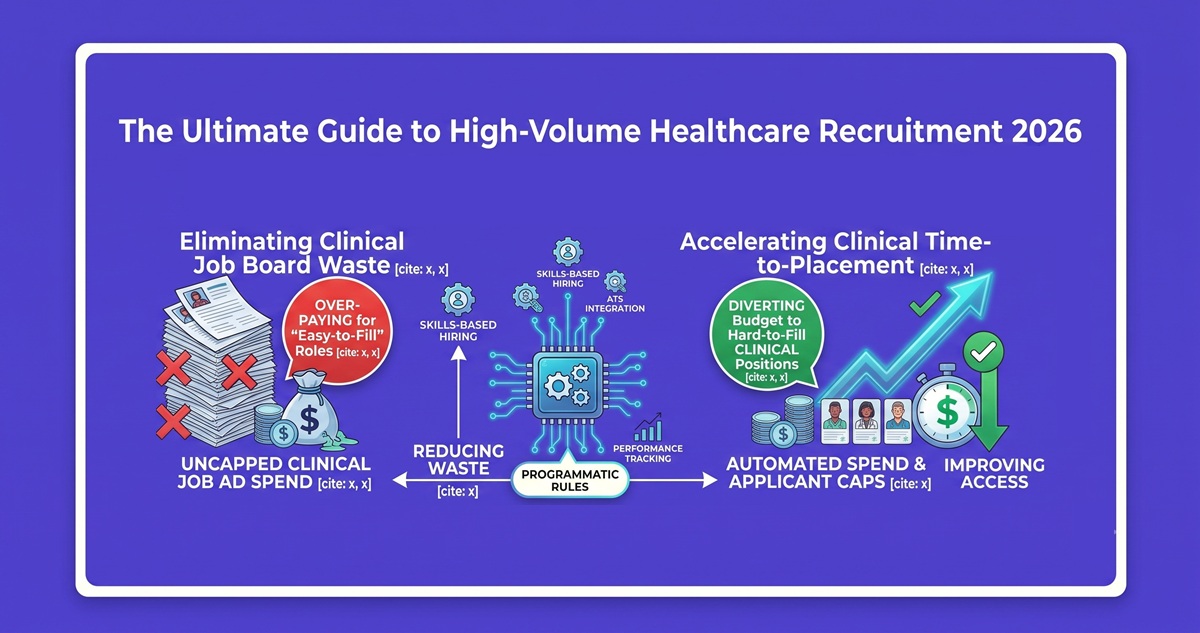
- The High-Volume Trap: Entry-level administrative or low-barrier care roles naturally generate massive click volumes. Job board algorithms favor these high-engagement postings, continually pushing traffic to them. If your media spend is uncapped, these “easy-to-fill” roles will happily devour thousands of dollars, piling up hundreds of duplicate or unqualified applications your sourcing team doesn’t need and cannot screen.
- The Starvation Effect: Meanwhile, your high-scarcity ICU RN or Lead Physical Therapist roles struggle to compete for algorithmic visibility. Because they yield fewer initial clicks, the job board engines suppress them. They sit completely starved for budget, staying vacant for months while costing the organization thousands in traveling nurse fees and lost operational revenue.
To win in 2026, you must enforce strict programmatic application and budget caps. The moment a Tier 1 or entry-level care role hits its optimal application threshold (e.g., 40 qualified applicants), the ad must immediately pause. The programmatic engine should then dynamically route those unspent dollars into premium, targeted bids for your high-scarcity clinical roles.
2. Transitioning from CPC to Cost-Per-Qualified-Candidate (CPQC)
For over a decade, digital recruitment marketing chased top-of-funnel metrics: impressions, clicks, and raw application volume. In a specialized industry like healthcare, this model is fundamentally broken. A massive spike in single-click, unstructured applications doesn’t solve a staffing shortage—it simply bogs down your recruiters in admin work.
Sophisticated healthcare TA leaders have officially retired the Cost-Per-Click (CPC) metric. The modern standard is Cost-Per-Qualified-Candidate (CPQC).
Building a Closed-Loop Feedback Loop
To successfully target CPQC, your programmatic job distribution platform must have a seamless, real-time integration with your Applicant Tracking System (ATS)—whether you use Workday, iCIMS, Oracle Recruiting, or Greenhouse.
[ Job Distribution / Aggregators ] ───(Clicks & Traffic)───► [ Candidate Application ]
▲ │
│ (Knockout Questions Pass)
│ ▼
[ Dynamic Budget Re-routing ] ◄───(Real-Time Webhook)─── [ Enterprise ATS Pipeline ]
When a high-volume candidate applies, your system shouldn’t just count the submission. A secure webhook must monitor whether that candidate passes critical healthcare knockout criteria, such as:
- Active state licensure/certifications (e.g., unencumbered RN license).
- Willingness to work specific shift patterns (e.g., night-shift rotations).
- Required background clearances and health screenings.
If a candidate satisfies these parameters, the ATS sends a “Qualified” signal back to your sourcing engine. By anchoring your programmatic bidding rules to CPQC, your budget automatically flows toward the platforms, job boards, and regional networks generating actual, credentialed clinicians—while starving the channels that only drive empty clicks.
3. Optimizing for Generative and Answer Engine Search (GEO / AEO)
The way clinical professionals search for jobs has fundamentally shifted. Healthcare workers are busy, mobile-first, and increasingly bypassing the traditional keyword search bars on legacy job aggregators. Instead, they are turning to conversational AI assistants, interactive discovery feeds, and personal voice assistants to navigate their career options.
This evolution requires healthcare employers to replace standard Search Engine Optimization (SEO) with Generative Engine Optimization (GEO) and Answer Engine Optimization (AEO).
How to Structure Clinical Requisitions for AI Search:
- Natural Conversational Prose: Modern clinicians ask AI tools hyper-specific, contextual questions: “Find me an evening-shift pediatric nursing job in Atlanta that offers tuition reimbursement and childcare stipends.” If your job descriptions are just rigid bulleted lists of responsibilities, generative engines will overlook them. Write your listings using natural language that answers these specific quality-of-life queries.
- Schema Markup and Structured Metadata: Ensure your career site backend utilizes flawless, structured schema data. AI search engines crawl for highly objective variables. If your shifts, location details, base pay ranges, and required credentials aren’t cleanly structured in your metadata, conversational engines cannot accurately index your roles for prospective candidates.
4. The 2026 Healthcare Sourcing Matrix
To scale your high-volume operations with precision, segment your hiring needs into distinct programmatic tiers. Each tier requires a completely localized capping, bidding, and routing strategy:
| Staffing Tier | Role Examples | Sourcing Difficulty | Programmatic Automation Rule |
| Tier 1: High-Velocity Frontline | CNAs, Medical Assistants, Phlebotomists, Patient Care Techs | Moderate volume; high turnover; fast conversion. | Strict Application Volume Caps: Automatically pause ads at 35 total applicants. Restrict daily spend to a rigid sandbox ($15/day max) to prevent budget monopolization. |
| Tier 2: Core Clinical Staff | Staff RNs, Specialized Technologists, Physical Therapists | High scarcity; intense regional competition. | Closed-Loop ATS Status Caps: Keep ads active until exactly 6 candidates pass the recruiter pre-screen and advance to “Hiring Manager Review” inside the ATS. |
| Tier 3: Advanced & Niche Care | Nurse Practitioners, CRNAs, Physician Assistants, Surgeons | Severe scarcity; long sales cycles; low applicant volume. | Uncapped Dynamic Routing: Eradicate volume caps. Program the platform to automatically harvest any budget saved from Tier 1 caps and use it to execute aggressive micro-bidding for premium positioning on niche clinical networks. |
5. Balancing Agentic Automation with Human Guardrails
With autonomous software managing your job distributions, bidding structures, and budget routing, a high-volume healthcare recruitment engine can execute thousands of micro-adjustments a day. However, true TA leadership requires balancing this powerful automation with corporate governance and compliance.
The Guardrails of Ethical Clinical Sourcing:
- Financial Sandboxing: While you should let AI optimize budget allocation across facilities, always build hard financial ceilings at the department or regional level. This prevents an unexpected regional surge from draining funds allocated to other critical hospitals within your network.
- Algorithmic Objectivity: Ensure your programmatic engine is optimized strictly against objective performance data—such as conversion rates, credentials passed, and channel retention metrics. This removes human subjectivity from the media-buying process and eliminates compliance risks.
- The High-Touch Human Interface: Automation should never replace the human element where it matters most. By leveraging automated capping and routing to eliminate administrative waste, you free up your healthcare recruiters to do what they do best: build deep relationships with clinicians, accelerate interview scheduling, sell your organization’s culture, and deliver a supportive, high-touch onboarding experience.
Conclusion: The Automated Care Engine
High-volume healthcare recruitment in 2026 is an exercise in resource optimization. You cannot afford to let your recruitment marketing budget leak into over-saturated pools while your critical care units face costly staffing deficits.
By deploying automated programmatic caps, locking your bidding to downstream Cost-Per-Qualified-Candidate metrics, and structuring your digital footprint for next-generation AI search engines, you transform your recruitment strategy from a cost center into a predictive asset. The future of healthcare talent acquisition is fast, automated, and strictly aligned with clinical outcomes. It’s time to build your ecosystem.